
Best Non-Toxic Clothing Brands: A Product-Level Buying Guide
Organization-authored. Editorial policy · Report an error
No single label proves that every item from a brand is non-toxic. Compare individual garments by their complete fiber blend, finishes, product-specific certification evidence, and what the seller does not disclose.
Reviewed options you can actually check
Selection reviewed 2026-09-05. These are named next steps with disclosed-composition evidence. They are not a medical ranking, a PFAS-free guarantee, or wear-tested dupes.
- Visible scored catalog items with a disclosed fiber mix, not a brand-wide safety slogan.
- Close-contact or everyday use first: tees, shorts, and elevated basics.
- Certifications counted only when they appear on the product record, with their own scope.
- Score order is not a 'closest dupe' or medical ranking. Affiliate compensation does not change this list.
Maggie's Organics
Everyday cotton basics
Catalog items disclose organic or regenerative cotton rather than a brand-level non-toxic promise.
Organic fiber is a farming/processing claim, not proof that a finished garment lacks every dye or finish.
Current catalog example: 100% Regenerative Organic Certified® Cotton - Layering Tee (100/100; Regenerative Organic Cotton 100%; listed certifications: Global Organic Textile Standard (GOTS)). Price and availability are not used in this ranking; check the current retailer listing. Retailer source recorded in the catalog
MATE the Label
Organic cotton tees
Scored tees in the catalog list organic cotton with product-level composition instead of a category-wide health claim.
Check the exact SKU. A tee score does not cover the rest of the line.
Current catalog example: Organic Pima Classic Tee (100/100; Regenerative Organic Cotton 100%; listed certifications: Global Organic Textile Standard (GOTS)). Price and availability are not used in this ranking; check the current retailer listing. Retailer source recorded in the catalog
Vessel of Thrns
Linen shorts and warm-weather pieces
High-scoring catalog items disclose linen rather than synthetic performance blends.
Linen identifies the fiber. It does not disclose dye or finish chemistry.
Current catalog example: The Linen Short (99/100; Linen 100%; listed certifications: OEKO-TEX Standard 100). Price and availability are not used in this ranking; check the current retailer listing. Retailer source recorded in the catalog
Quince
Elevated natural-fiber essentials
The catalog and alternatives hub let you compare disclosed fiber mixes item by item instead of treating the brand as uniformly non-toxic.
Quince listings still need a product-specific finish and certification check. Brand-level marketing is not the score.
Current catalog example: 100% European Linen Short Sleeve Shirt (99/100; Linen 100%; listed certifications: OEKO-TEX Standard 100). Price and availability are not used in this ranking; check the current retailer listing. Retailer source recorded in the catalog
Some product links may be affiliates. Compensation never changes scores, ranking, or who appears on this shortlist.
Non-toxic clothing is about reducing your daily exposure to chemicals from the fabrics touching your skin. The focus is health-first, particularly for high-contact items like underwear, activewear, and baby clothes. Since there is no single "good" or "bad" material, context matters. An informed decision compares disclosed fibers, finishes, and certification scope. It does not establish a reduction in a person's chemical exposure.
What People Commonly Assume
It’s reasonable to see a “100% Cotton” tag and think it’s inherently safe. If a fabric comes from a plant, how could it be a health concern? This assumption overlooks the industrial journey from field to finished garment. The fiber itself is just the start. What touches your skin is the sum of every step: growing, processing, dyeing, and finishing.
The Health Tradeoffs in Your Closet
Every garment represents a series of tradeoffs. There’s no perfect fabric—only what’s best for a specific situation. This forces us to weigh a clothing’s performance against potential chemical exposure.
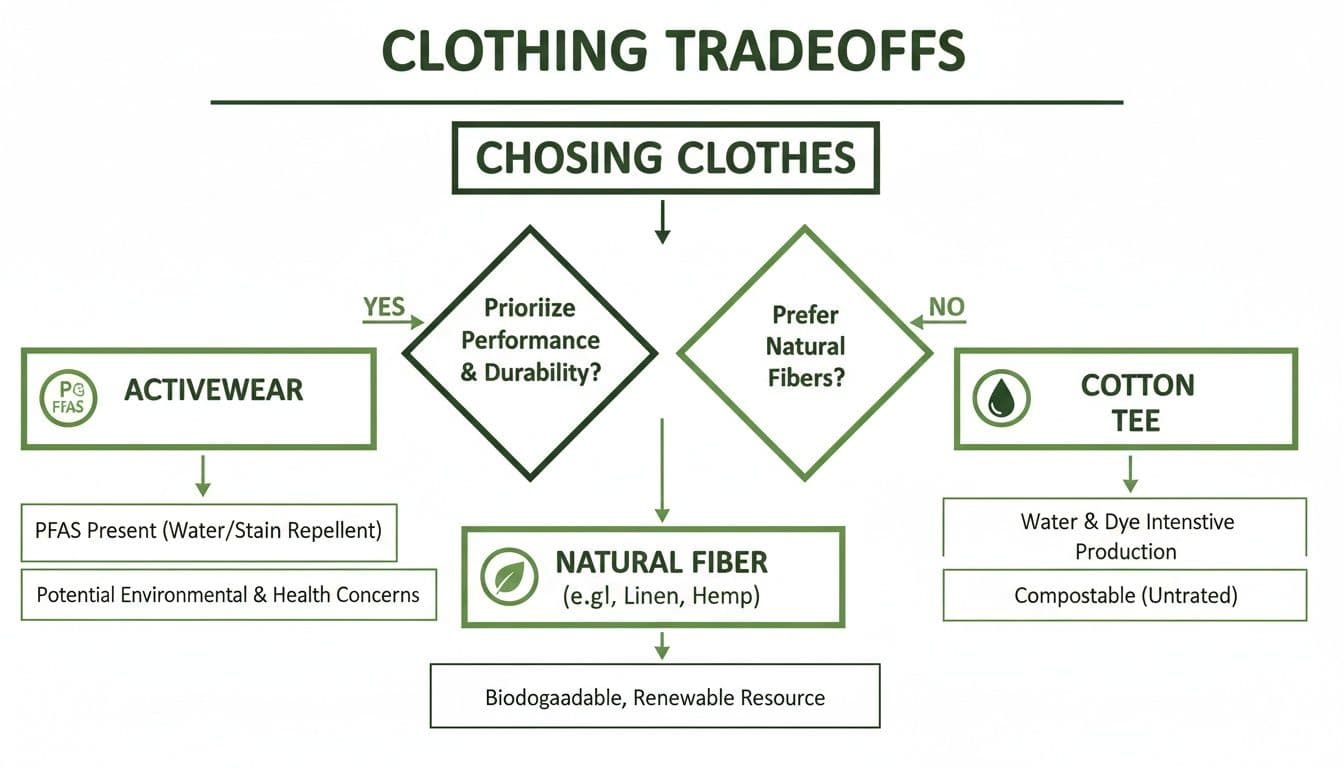
Conventional cotton breathes well. The fiber name does not identify the dye. Some azo colorants can release listed aromatic amines; that is a dye-chemistry question, not proof that a particular pair of underwear contains those dyes.
Here are some common tradeoffs to consider:
-
Performance vs. Purity: A synthetic workout shirt wicks sweat effectively. The tradeoff is that it might be treated with PFAS (per- and polyfluoroalkyl substances) for water resistance and will shed microplastics in the wash. Heat and sweat can change how a finish or dye behaves, but a product page cannot establish transfer, dose, or a health outcome for a specific shirt.
-
Color vs. Chemicals: You can avoid most chemical risks by choosing undyed natural fibers like raw linen. The compromise is functional and aesthetic. You miss out on vibrant color options and performance features like stretch, and the fabric may feel rougher initially. This is where the tradeoff becomes less obvious.
-
Synthetics vs. Microplastics: A standard polyester fleece jacket is a major source of microplastic pollution with every wash. A tightly woven wool jacket avoids that issue but comes with different care requirements and a higher cost.
What to Look For on Labels
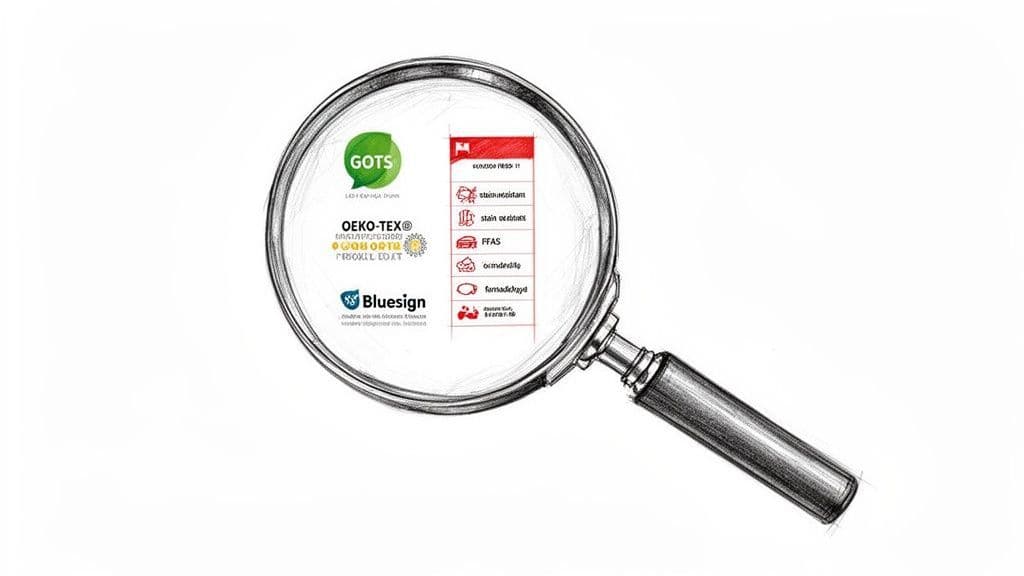
Learning to decode labels is the most important skill for finding safer clothes. Forget marketing terms like “eco-friendly” or “green”—they are unregulated. You are looking for specific, third-party certifications.
Key Certifications
Certifications are not all equal. Some focus on the farm, others the factory, and some the final product.
- GOTS (Global Organic Textile Standard): This is the leading standard for organic fibers. It doesn’t just mean the fiber was grown organically; it also restricts harmful chemicals like specific azo dyes and formaldehyde during every production step. A GOTS-certified garment offers high assurance of purity.
OEKO-TEX STANDARD 100 tests certified articles against current harmful-substance criteria and product-class limits. It does not mean the fibers are organic, and it is not a medical-safety verdict.
- Bluesign: Think of Bluesign as a supply chain auditor. It vets everything from chemical inputs to water and energy use. A Bluesign-approved fabric was made with responsible processes, signaling a lower chemical footprint.
Red Flag Terms
Certain performance claims are clues to chemical treatments. The quiet use of PFAS for features like stain-resistance is one of the most significant hidden health risks in modern apparel.
Keep an eye out for this language:
-
Stain-resistant or water-repellent: These features often rely on PFAS coatings. While brands are slowly shifting, they remain common. Our guide on how to avoid PFAS in clothing explains more.
-
Wrinkle-free or no-iron: This convenience usually comes from a formaldehyde resin finish. Formaldehyde-based resins may be used for wrinkle resistance. A fiber label does not reveal whether that finish was used or the residual amount on a finished garment.
-
Antibacterial or anti-odor: These functions may come from treatments with silver nanoparticles or other biocides. The long-term health effects of wearing fabrics embedded with these agents are not fully understood.
Key Takeaways
- "Natural" is not enough. A "100% Cotton" label says little about the dyes, finishes, and treatments used. The process matters more than the plant.
- Trust certifications, not claims. Look for GOTS or OEKO-TEX Standard 100. These are your proof of testing.
- Prioritize by skin contact. Start with underwear, pajamas, and activewear if those are the items you wear longest. That is a practical shopping order, not a measured exposure reduction.
- Exposure depends on use. A rain jacket worn occasionally has a different risk profile than a baby’s onesie worn 24/7.
- Transparency is the best indicator. A brand’s willingness to detail its materials, dyeing processes, and certifications is the most reliable sign of its commitment to safer products.
Limitations and Uncertainty
Finding perfectly "pure" clothing is not a realistic goal. Retailer disclosures are often incomplete, and without our own lab testing, we must rely on brand reporting. Furthermore, the science on textile chemicals is still evolving. The aim is to make a series of informed choices that reduce your cumulative exposure over time.
View all the products at Greener Closet that have already been scored