
Chemicals in Polyester Clothing: What Labels Can—and Can't—Tell You
Organization-authored. Editorial policy · Report an error
A polyester label tells you the garment's fiber content—not every catalyst residue, dye, coating, or finish used to make it. Polyester alone does not prove that PFAS or another substance is present or absent, and it cannot establish personal exposure or health risk. Check the exact product's current disclosures and the scope of any certification.
Polyester is a synthetic fiber, usually polyethylene terephthalate (PET). Turning it into a finished garment can involve catalysts, dyes, and performance finishes, but a fiber-content label does not identify those inputs or show what remains on a specific item. Treat the label as a starting point—not a chemical test or a health verdict.
What People Commonly Assume
Polyester is common in leggings, workout tops, fleece, and outerwear because it can be durable, quick-drying, and easy to blend. Those performance properties do not disclose which dyes or finishes were used on a particular garment.
Product testing and certification claims vary in scope. Check the exact product, certificate, and substances covered instead of assuming that a performance claim is also a chemical-safety claim.
The Tradeoffs of Polyester on Your Skin
The conversation around polyester isn't about whether it's "good" or "bad." It's about understanding the specific tradeoffs, especially for items that touch your skin for hours.
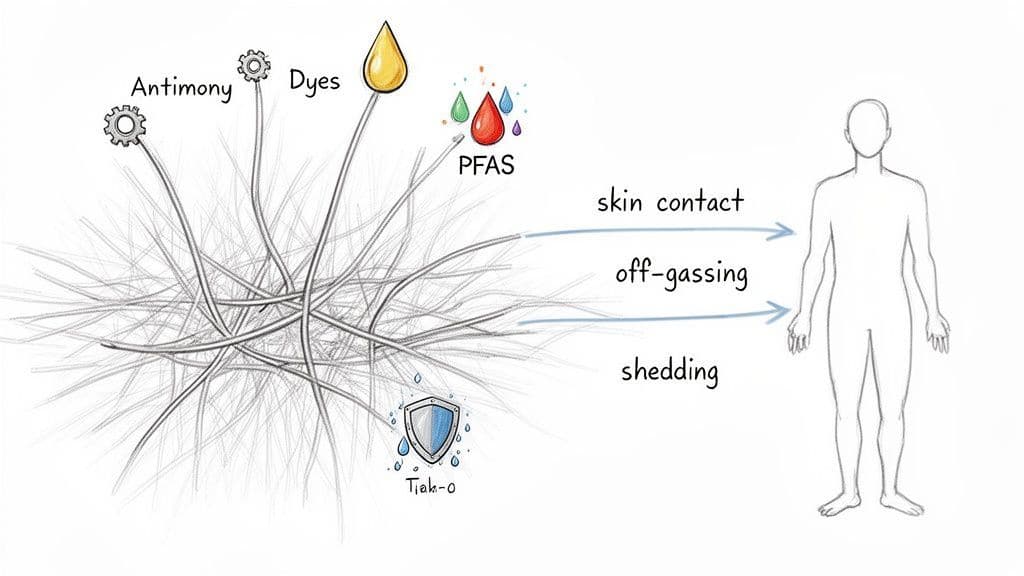
The useful question is not whether every polyester garment has the same chemical profile. It is what can be verified for the exact item:
-
Catalyst residues: Antimony compounds are commonly used as catalysts in PET production. A laboratory study found measurable but variable antimony release from sampled polyester textiles into artificial-sweat solutions; it did not establish the exposure or health effect from wearing a particular garment. A fiber label does not report catalyst residues. Read the study abstract.
-
Dyes and Skin Sensitivity: Disperse dyes are used with synthetic fibers, and some are documented textile-contact allergens. The evidence does not justify treating every disperse dye—or every dyed polyester garment—as equivalent. If you suspect textile dermatitis, seek clinical guidance rather than trying to diagnose the dye from a label. Review the clinical evidence.
-
Performance finishes: The EPA reports that some textile facilities use PFAS to add water, grease, and stain resistance. That does not mean all polyester contains PFAS, and fiber content alone cannot confirm whether a finish was used. Look for a current, product-specific PFAS-free or fluorine-free statement and read its scope. See the EPA textile-facility summary and our PFAS shopping guide.
-
Microfiber shedding: Polyester textiles can release plastic microfibers during wear and washing. The amount varies with fabric construction, use, age, and care, so a fiber label cannot predict an exact shedding rate for one item. Read our microplastics guide for the evidence and practical tradeoffs.
Polyester can still be a practical choice. Compare where and how you will use the garment, the full fiber blend, the seller's product-specific disclosures, and any certification you can verify.
What to Look for on Labels
A “100% polyester” label identifies fiber content; it is not required to list every dye, finish, coating, trim, or non-fibrous component. The FTC Textile Fiber Rule explains the label's required scope. Product-specific certifications and restricted-substance disclosures can add evidence, but each has limits.
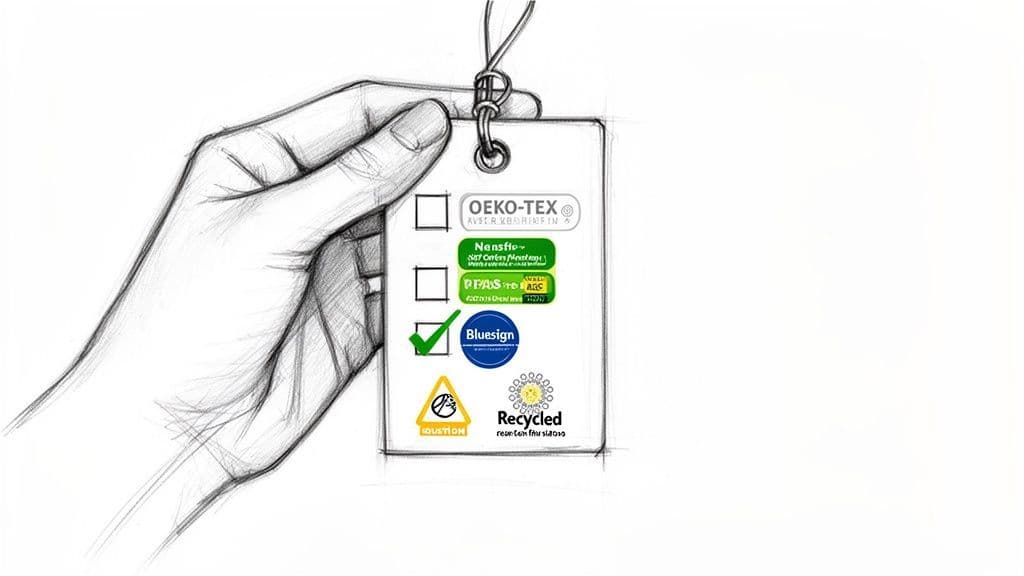
Treat broad marketing terms as incomplete unless the seller defines and supports them. For certification claims, verify the exact product and scope:
- OEKO-TEX STANDARD 100: Tests every component of a certified article against the standard's current harmful-substance criteria and product-class limit values. Verify the certificate and product class; do not translate the label into an unlimited “chemical-free” or medical-safety claim. Check the standard.
- bluesign: Different bluesign marks apply to approved chemicals, articles, materials, processes, or finished products. Verify which mark the item carries and what share of its components is covered instead of assuming every input is certified. Review the bluesign criteria.
- Specific claims: A product-level “PFAS-free” or “fluorine-free” statement is more useful than a broad sustainability slogan only when its date, product coverage, and definition are clear. Missing disclosure means unknown, not present or absent.
“Recycled polyester” describes feedstock, not the dyes, finishes, or residues on a finished garment. Do not infer that recycled and virgin polyester have either identical or automatically safer chemical profiles without product-specific evidence.
Key Takeaways
The goal is not to avoid polyester entirely but to understand its chemical profile and make selective choices.
- Separate fiber from finish: Polyester identifies the fiber. It does not establish which catalyst residues, dyes, coatings, or finishes are present on the finished item.
- Compare the use case: For close-contact or performance clothing, prioritize complete composition and product-specific finish disclosures; use certifications as scoped evidence, not a blanket verdict.
- Verify certifications: Match a certificate or product listing to the exact item and read what it covers. A brand-level logo alone is not enough.
- Do not treat recycled content as a purity claim: Feedstock and finished-product chemistry are separate questions.
Limitations and Uncertainty
A public product page and fiber label cannot establish a wearer's exposure or health outcome. Exposure depends on the specific substance, amount, route, garment, and use conditions.
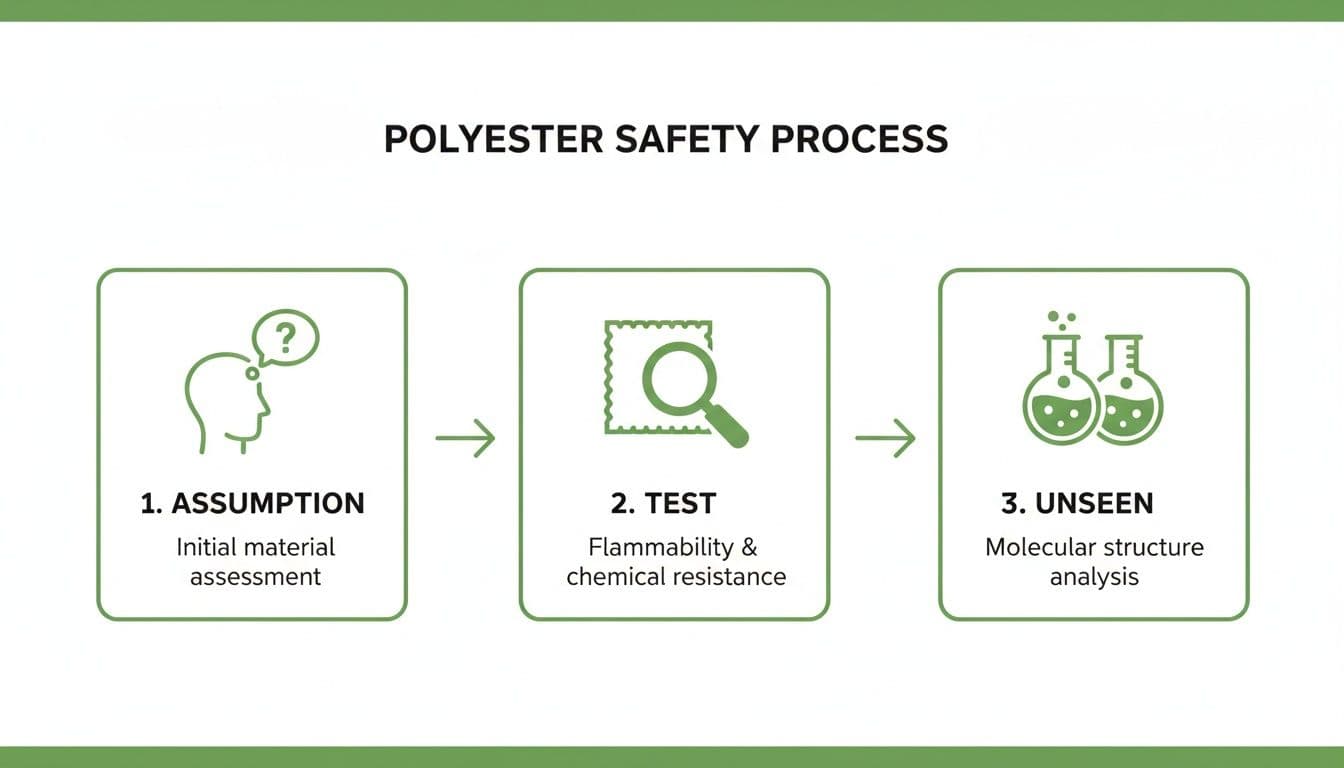
Greener Closet has not lab-tested the garments discussed here. This guide explains disclosure limits and evidence to check; it does not diagnose sensitivity, estimate an individual's exposure, or prove that a chemical is present or absent from a specific product.
At Greener Closet, we believe understanding your clothing's impact should be straightforward. Our tools are designed to help you analyze products beyond the label.