
The Real Impact of Fast Fashion on Your Health
Organization-authored. Editorial policy · Report an error
Fast fashion's environmental damage is well-documented—it consumes massive amounts of water, pollutes rivers, and contributes to climate change. But the most immediate impact isn't on a distant ecosystem; it's on the environment right next to your skin. The chemicals used to produce cheap, trendy clothing can have direct consequences for your body, making this an issue of personal health first and foremost.
What People Commonly Assume
It's easy to see why people think one good wash is enough to remove anything harmful from new clothes. That first wash does rinse away surface residues. The issue is that many chemicals aren't just on the fabric; they're chemically bonded to it to achieve a specific color or performance feature, like water resistance.
The Tradeoffs of Fast Fashion Fabrics
The features that make fast fashion appealing often come with health-related tradeoffs. The chemicals that make a jacket water-repellent or a shirt wrinkle-free don't always stay in the fabric. This can lead to low-level, continuous exposure through what touches your skin.
-
Chemical Exposure: Certain synthetic dyes (azo dyes) and performance finishes (PFAS, formaldehyde) are potential concerns. Dyes can break down into suspected carcinogens through contact with sweat and friction. PFAS, known as "forever chemicals," are used for stain resistance and can be absorbed through the skin, while formaldehyde is a known skin irritant.
-
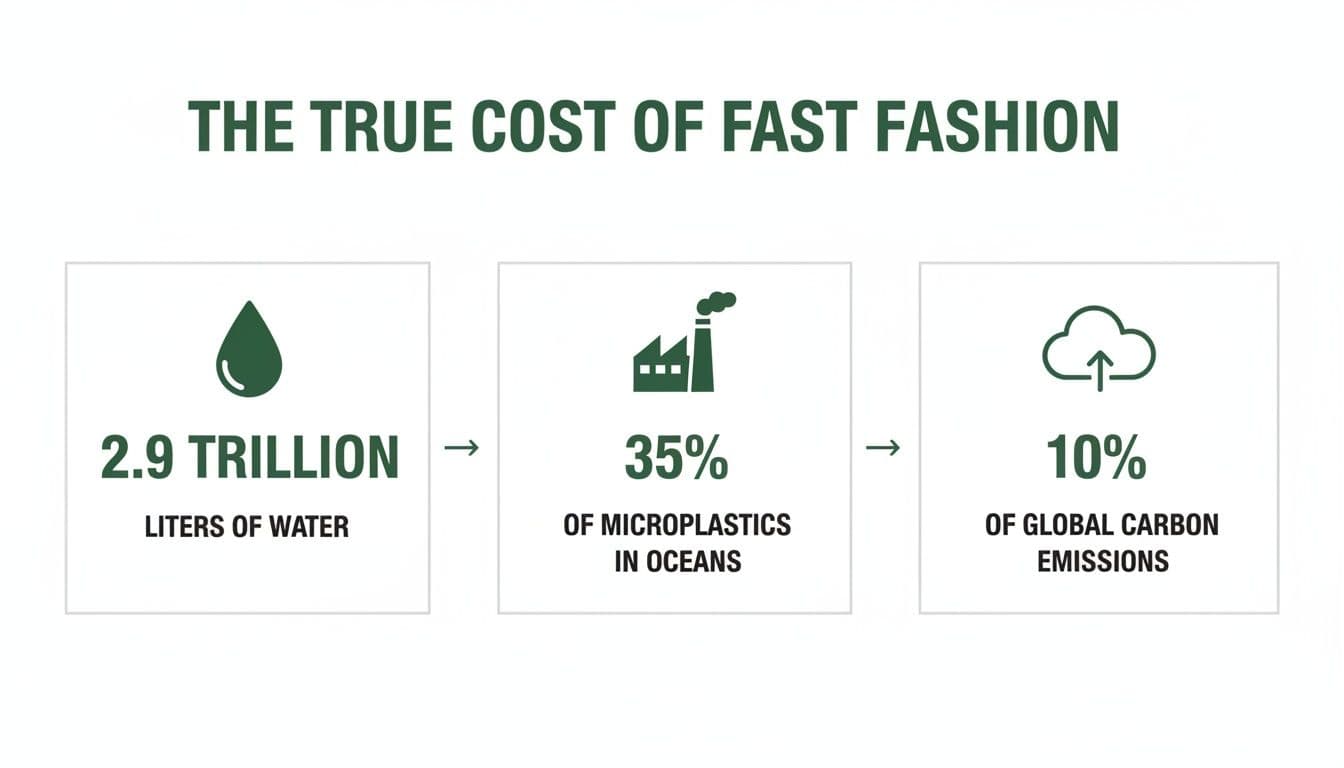
Microplastic Shedding: Synthetic fabrics like polyester and nylon release thousands of microscopic plastic fibers with every wash. These microplastics contaminate waterways, enter the food chain, and ultimately, a single person can ingest up to a credit card’s worth of plastic each week.
-
Environmental Burden: The production of these clothes has a significant environmental footprint. A single conventional cotton t-shirt can require up to 700 gallons of water to produce, and the fashion industry is responsible for up to 10% of global carbon emissions, largely driven by fossil fuel-based synthetics and global supply chain of the fashion industry.
This is where the tradeoff becomes less obvious. A wrinkle-free shirt saves you a few minutes of ironing, but it may mean all-day exposure to finishing agents. The context of how and where you wear a garment—like a synthetic fleece jacket washed weekly—matters.
What to Look for on a Label
That small tag is your best tool for making an informed decision. It's not about finding a "perfect" material, but about understanding what you're bringing into contact with your body.
-
Material Composition: Is it 100% organic cotton or a polyester/spandex blend? This tells you about potential microplastic shedding and the agricultural footprint.
-
Certifications: These are shortcuts to trust. GOTS (Global Organic Textile Standard) restricts harmful chemicals in natural fibers. OEKO-TEX Standard 100 certifies that the final product has been tested for over 350 harmful substances, including PFAS and certain azo dyes.
-
Performance Claims: Be analytical about terms like "wrinkle-resistant" or "stain-repellent." These features are often achieved with chemical treatments.
Key Takeaways
-
Health is the Primary Impact: The fast fashion environmental impact is also a personal health issue, driven by chemical exposure from clothing worn directly on the skin.
-
Every Fabric is a Tradeoff: Natural fibers often have a high water footprint, while synthetics shed microplastics and rely on fossil fuels. No material is universally "good" or "bad."
-
Read the Label: Your most reliable information comes from the material composition and certifications like GOTS or OEKO-TEX, not the brand's marketing.
-
Context Matters: A waterproof synthetic jacket worn occasionally presents a different exposure scenario than synthetic underwear worn daily.
Limitations and Uncertainty
It's important to acknowledge what is not yet fully understood. Research into the long-term health effects of low-dose chemical exposure from textiles is still evolving. Retailers rarely disclose all finishing agents used, creating information gaps for consumers. Individual sensitivity to chemicals also varies significantly.
View all the products at Greener Closet that have already been scored