
Analyzed Product Profile
Vuori
This Analyzed Product Profile is based on 123 distinct analyzed products in the Greener Closet catalogue. Median, range, and material mix are computed from those products' disclosed composition. They are not a corporate sustainability score.
Sample and scores
Most common materials
Counted by distinct product, not fiber percentage. One product can appear in several rows.
| Material | Products |
|---|---|
| Elastane | 110 |
| Recycled Polyester | 67 |
| Polyester | 43 |
| Polyamide | 17 |
| Cotton | 11 |
| Recycled Nylon | 5 |
Category mix
| Category | Products |
|---|---|
| Pants | 54 |
| Shorts | 48 |
| Activewear | 31 |
| Shirts | 8 |
| Sweatshirts | 7 |
| Bras | 3 |
Highest-scoring analyzed products

Optimist Pant
Brand: Vuori

Vuori AllTheFeels™ Cami Bra
Brand: Vuori
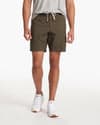
Ripstop Short
Brand: Vuori
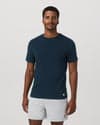
Tuvalu Tee
Brand: Vuori

Pose Henley Jumpsuit
Brand: Vuori

Fletcher Chino Short 8"
Brand: Vuori

Long Sleeve Cove Ultra Scoop
Brand: Vuori

Restore Full Zip Hoodie
Brand: Vuori
How these scores are produced
Product scores on this page are produced automatically. We read the composition and certification details a retailer discloses on the product page, match each material to our research database, and apply the published clothing-score process: every product starts at 100; five material factors — microplastics, PFAS, material half-life, production energy, and fiber shedding — apply penalties weighted by how much of the garment that material makes up; a sixth factor, azo dyes, applies to the garment as a whole; and a small adjustment reflects whether any certification was disclosed. GOTS, bluesign, OEKO-TEX Standard 100, and Cradle to Cradle can also mark a product azo-dye-free. We do not lab-test garments. The Analyzed Product Profile then summarizes those product scores. It is not a corporate sustainability score, and it is not the retired LLM brand assessment.
Are you this brand?
If a figure on this page is wrong, send a correction. We aim to respond within 24 hours. A review can temporarily hide a disputed claim; it is not an automatic permanent removal.
Sourced corporate evidence
These are sourced claims, not a corporate score. Missing topics are not assessed, not scored as zero.
Vuori states that its Tier 1 manufacturing vendors must follow a Vendor Code of Conduct based on International Labour Organization core labor standards, covering areas including child labor, forced labor, wages and benefits, working hours, freedom of association, health and safety, and environmental responsibility.
company_disclosure
Vuori states that its manufacturing partners may not use forced, slave, prison, bonded labor, or human trafficking, and that workers should retain control of their citizenship documents.
company_disclosure
Vuori states that employees at its factories have the right to freedom of association, collective bargaining, and participation in workers’ unions or organizations without harassment or penalty.
company_disclosure
Vuori reports 2024 brand-wide carbon footprints of 115,667 metric tons of CO2-equivalent on a location-based basis and 113,864 metric tons on a market-based basis. It states that the measurements follow the GHG Protocol and were assured by third-party consultants.
company_disclosure
Vuori states that approximately 56% of its total fabric spend in 2024 used Vuori Preferred Fibers.
company_disclosure
Vuori states that its supply-chain emissions account for approximately 98% of its overall carbon footprint, while direct and indirect onsite emissions account for approximately 2%.
company_disclosure
Vuori states that it does not own the factories that make its garments and instead partners with manufacturing groups.
company_disclosure
Vuori states that it has partnered with CleanHub since 2019 to remove plastic waste from coastal communities.
company_disclosure
Vuori’s supply-chain policy states that water, energy use, material waste, chemical management, and animal welfare are environmental impacts for which the company says it will be accountable, and that manufacturing partners must maintain written environmental policies and responsibly handle effluents.
company_disclosure
A Climate Label directory page states that Vuori’s Climate Label certification has expired and that the brand is no longer meeting the requirements of that certification standard.
certification_registry
- Conflicting evidence — Climate-related certification status
- Not assessed — Animal-welfare performance and outcomes
- Not assessed — Living-wage implementation and outcomes