
Best Eco-Friendly Clothing Brands: Named Options You Can Check
Organization-authored. Editorial policy · Report an error
Eco-friendly is unregulated. Compare named brands by disclosed fiber mix, product-specific certifications, and a current catalog example when we have one. Recycled polyester is a feedstock claim, not a health upgrade.
Named options, with what we can verify
Selection reviewed 2026-09-05. These are named next steps with disclosed-composition evidence. They are not a medical ranking, a PFAS-free guarantee, or wear-tested dupes.
- The page names brands a shopper can open next, then shows a current catalog example when we have one.
- Selection is disclosed fiber class, certifications on the record, and a clear use case—not a generic eco slogan.
- Recycled polyester can reduce virgin feedstock and still shed microfibers. It is not treated as a health upgrade by default.
- Affiliate compensation does not affect inclusion or order.
Maggie's Organics
Organic cotton basics
Catalog tees disclose regenerative or organic cotton, which is a checkable farming claim.
Farming claims do not replace dye, finish, or factory evidence.
Current catalog example: 100% Regenerative Organic Certified® Cotton - Layering Tee (100/100; Regenerative Organic Cotton 100%; listed certifications: Global Organic Textile Standard (GOTS)). Price and availability are not used in this ranking; check the current retailer listing. Retailer source recorded in the catalog
Quince
Cashmere, silk, and cotton essentials
Item-level composition is comparable on the Quince alternatives and Quince vs Everlane pages.
Price and country of origin still have to be read on the current product page.
Current catalog example: 100% European Linen Short Sleeve Shirt (99/100; Linen 100%; listed certifications: OEKO-TEX Standard 100). Price and availability are not used in this ranking; check the current retailer listing. Retailer source recorded in the catalog
Everlane
Transparent basics with mixed fiber stories
The catalog and comparison page show disclosed materials rather than a single eco grade for the brand.
Some Everlane programs use recycled synthetics. Treat those as feedstock claims, not chemical-safety claims.
Current catalog example: The Box-Cut Tee in Essential Cotton (97/100; Organic Cotton 100%; listed certifications: Organic Content Standard (OCS), OCS 100). Price and availability are not used in this ranking; check the current retailer listing. Retailer source recorded in the catalog
Patagonia
Outdoor layers where finish chemistry matters
Public PFAS-exit statements are checkable at the product or program level; the catalog score still uses disclosed composition.
A brand commitment is not a lab result for every jacket. Read the exact item's current finish language.
Current catalog example: Men's '73 Skyline T-Shirt (97/100; Organic Cotton 100%; listed certifications: Fair Trade Certified, bluesign® approved). Price and availability are not used in this ranking; check the current retailer listing. Retailer source recorded in the catalog
Some product links may be affiliates. Compensation never changes scores or this shortlist.
Finding the best eco-friendly clothing brands is less about the planet and more about what touches your skin. The useful comparison is disclosed fiber mix, finish claims, and certification scope—not a promise that a brand lowers your daily chemical exposure. A health-first approach simplifies the search, focusing on material safety over vague environmental claims.
What People Commonly Assume About "Eco-Friendly" Clothing
It's easy to see why buying a fleece jacket made from recycled plastic bottles feels like a good decision. The logic seems sound: turning waste into a wearable product is a clear environmental win, and by extension, it should be a healthier choice. This is where the narrative becomes more complex.
While recycling is a critical part of waste reduction, it doesn't automatically erase potential health concerns tied to the original material. The tradeoffs aren't always obvious. What touches your skin matters, and the source of that material—even if recycled—is part of the story.
The Tradeoffs of "Green" Materials
Every clothing choice involves a series of tradeoffs between performance, cost, and health. No material is perfect; understanding the compromises is key to making an informed decision.
-
Conventional vs. Organic Cotton: Conventional cotton farming can involve pesticides. A cotton label does not report those inputs or residues on a finished shirt. Organic cotton is a farming-standard claim; it does not automatically describe dye or finish chemistry. This is where the tradeoff becomes less obvious, balancing budget against chemical exposure.
-
Performance Finishes: Your waterproof jacket is a practical example. Many are treated with a durable water repellent (DWR) finish made from per- and polyfluoroalkyl substances (PFAS). The EPA summarizes PFAS as a persistent chemical class with ongoing health and environmental research. A jacket listing still has to show whether a PFAS finish was used on that item. An alternative is a PFAS-free finish, which may require more frequent re-application.
-
Recycled Synthetics: A fleece made from recycled polyester still sheds microplastic fibers with every wash. Synthetic textiles can shed plastic microfibers during washing. Recycled polyester describes feedstock, not the dyes, finishes, or a measured shedding rate for one fleece.
-
Dyes and Colors: Most clothing uses azo dyes, a family of synthetic colorants. A small subset of these can break down and release aromatic amines, which pose known health risks. Natural or low-impact dyes are alternatives, but they may offer a more limited color palette and can be less colorfast over time. The one fabric you wear for eight hours straight, like your underwear, is a good place to prioritize safer dyes.
What to Look For on Labels and Product Pages
A brand serious about health will not hide important details. Vague terms like ‘eco-conscious’ are a potential red flag; specific claims like ‘PFAS-free’ are a positive signal.
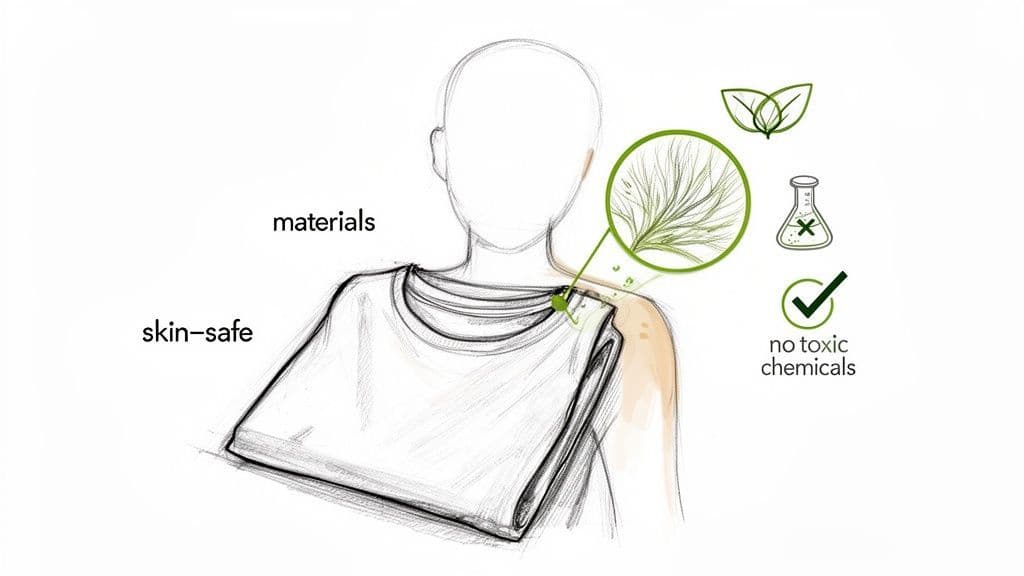
Actionable Checklist
-
Check the material composition first. Is it a natural fiber like organic cotton, linen, or hemp? Or is it a synthetic like polyester or nylon? This is the single most important factor. For more, see our guide on the healthiest fabrics to wear.
-
Look for chemical disclosures. Scan the product description for phrases like "PFAS-free," "non-toxic dyes," or "chlorine-free processing." Silence on these topics can be telling.
-
Verify with third-party certifications. These are your most reliable indicators. GOTS (Global Organic Textile Standard) is the most stringent for health, covering the entire process from farm to finished garment. OEKO-TEX Standard 100 certifies that the final product has been tested for a list of harmful substances.
-
Assess brand-level transparency. Does the company openly discuss its supply chain, factories, and dyeing processes? A willingness to share details—beyond just recycled packaging—is a strong indicator of a brand's priorities. The modern clothing supply chain is so complex and opaque that any brand claiming 100% purity is almost certainly misleading you.
Brand Recommendations
The following brands stand out for their material safety, verified claims, and transparency.
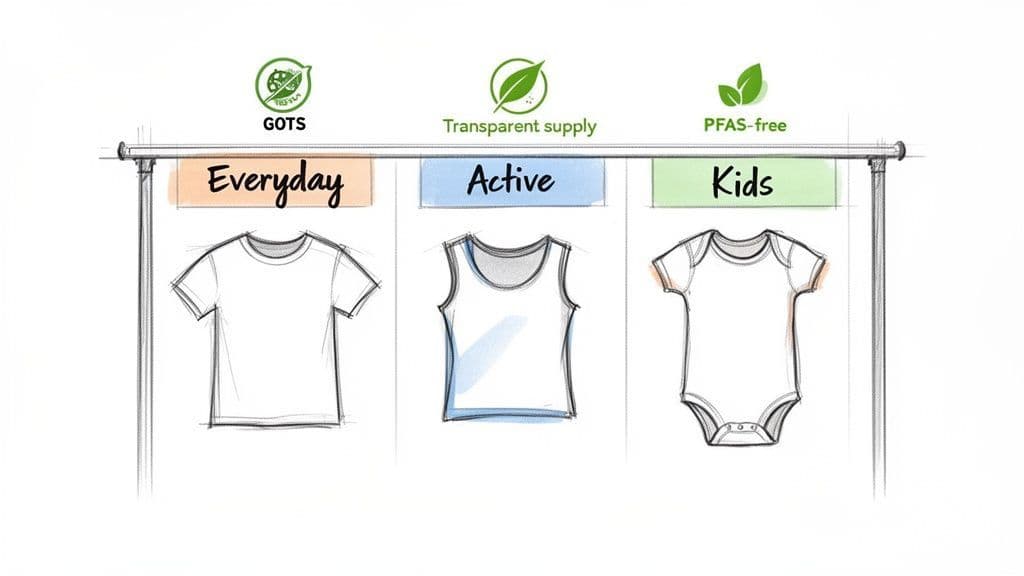
For Everyday Basics
For items worn directly against the skin, certified organic fibers are the priority.
- Pact: Relies almost exclusively on GOTS certified organic cotton, which provides strong assurance against pesticide residues and harsh processing chemicals.
- Kotn: Offers exceptional supply chain transparency by working directly with cotton farming families, giving them a clear line of sight from farm to fabric.
For Performance and Activewear
This category requires balancing function with safety. The main focus here is avoiding "forever chemicals."
- Patagonia: Has made a public commitment to eliminate PFAS from its water-repellent finishes—a significant move to reduce exposure to this toxic class of chemicals. Girlfriend Collective: Uses OEKO-TEX claims on some recycled activewear. Verify the certificate, product class, and which components are covered; recycled polyester is still a plastic fiber.
For Babies and Children
A child's system is more vulnerable to chemical exposure, making non-toxic materials a top priority.
- Colored Organics: Focuses exclusively on GOTS certified organic cotton and non-toxic, water-based dyes, avoiding risky finishes like flame retardants. Hanna Andersson: Has long used OEKO-TEX STANDARD 100 on many fabrics. That is scoped testing against the standard's current limits, not a medical-safety guarantee for every SKU.
Our analytical stance is that while many brands use "eco-friendly" as a marketing tool, true leadership is demonstrated by a verifiable commitment to removing specific, harmful chemicals from products. This is especially true for underwear, activewear, and children's clothing. For more on this, you can learn how to avoid PFAS in clothing or learn more about eco-friendly clothing materials. The same logic applies to other product categories, such as understanding the ethical considerations between sable and mink.
Key Takeaways
- Prioritize materials based on direct skin contact. Focus on safer fabrics for items you wear all day, like underwear and base layers.
- Look for specific, verifiable claims. "PFAS-free" is a meaningful statement; "eco-conscious" is not.
- Understand that all materials have tradeoffs. Recycled polyester (RPET plastic) reduces waste but sheds microplastics. Context matters.
- Use GOTS and OEKO-TEX certifications as your most reliable health and safety indicators.
Limitations and Uncertainty
This analysis is based on publicly available brand information and third-party certifications. No independent lab testing was performed. Research into the health effects of textile chemicals is still evolving, and individual sensitivity to materials can vary. Retailer disclosures often have gaps, making a complete assessment challenging.
View all the products at Greener Closet that have already been scored.