
Does 100% Cotton Include the Thread? What "Exclusive of Trim" Means
Organization-authored. Editorial policy · Report an error
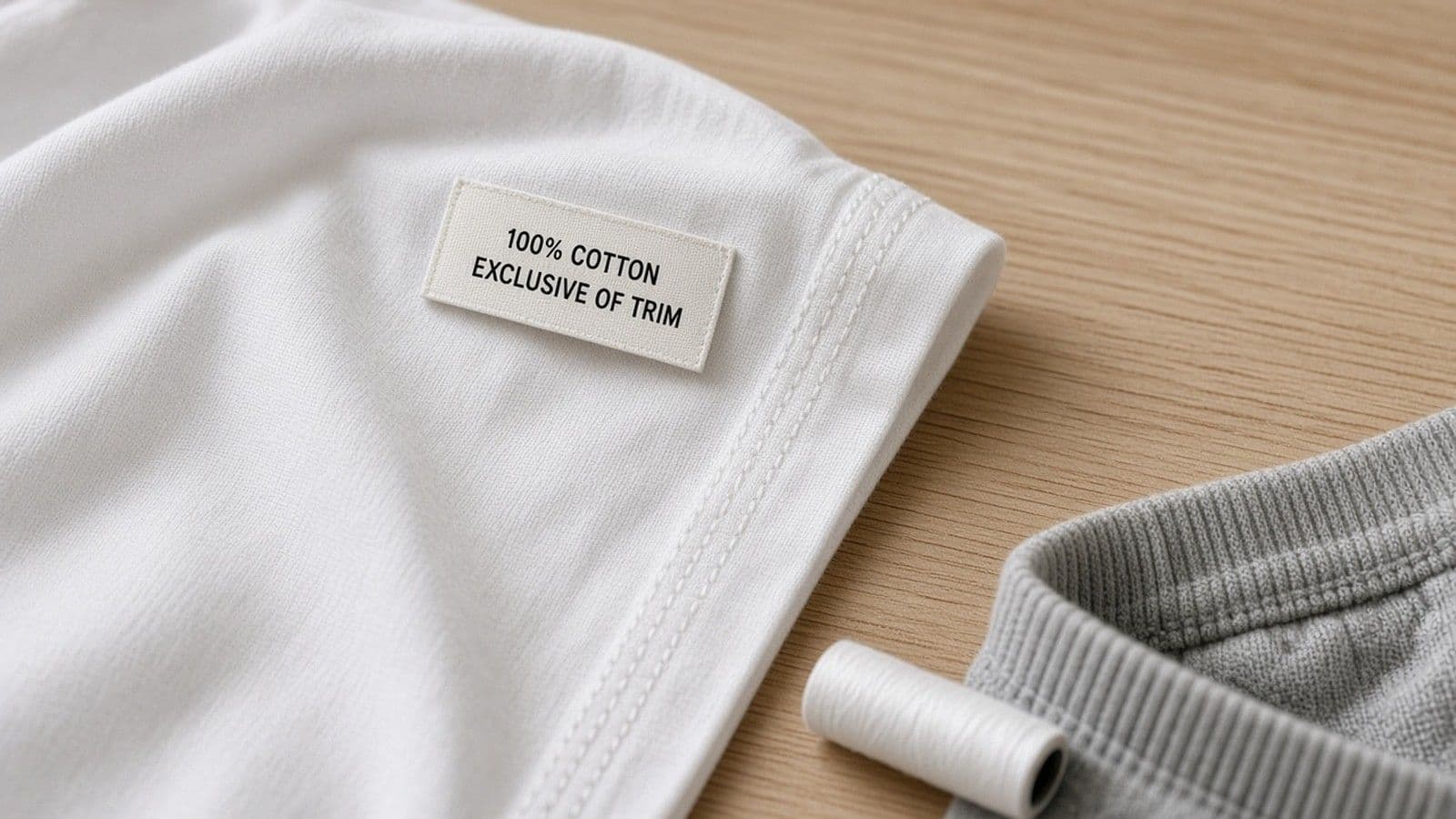
A shirt can say "100% cotton" on the label and still be sewn together with polyester thread, and that's completely legal in the US. The FTC's textile rules let "100% cotton" describe the main fabric only. Brands can leave out the seam thread and parts like waistbands, cuffs, collars, labels and some elastic. When a label adds "exclusive of trim" or "exclusive of decoration," it's telling you there are parts of the garment the percentages don't count.
If you've ever turned a cotton shirt inside out and wondered about the seams, you were reading the label right. It just covers less than it looks like it does.
What does 100% cotton mean on a label?
It means the main fabric is all cotton once certain parts are set aside. The rule is 16 CFR 303.27. It lets a brand use "All" or "100%" when a product, or a part of it, is made wholly of one fiber "other than any fiber ornamentation, decoration, elastic, or trimming as to which fiber content disclosure is not required." Its examples include "100% Cotton," "100% Acetate, Exclusive of Decoration" and "All Nylon, Exclusive of Elastic."
The parts that get set aside are listed in the trimmings rule, 16 CFR 303.12. Its list includes:
- Rickrack, tape, belting, binding and braid
- Labels
- Collars, cuffs, wrist bands, leg bands and waist bands
- Gussets, gores and welts
- "Elastic materials and threads inserted in or added to the basic product or garment in minor proportion for holding, reinforcing or similar structural purposes"
That last line covers the thread. The FTC's guide for sellers, Threading Your Way Through the Labeling Requirements, says it directly: the threads that hold the garment together don't have to be counted. So the brand doesn't have to name what the thread is made of.
Parts that aren't made of fiber don't have to go on the fiber content label. The same guide says zippers, buttons, beads, sequins, leather patches and painted designs can stay off because they aren't made from fiber, yarn or fabric.
What "exclusive of decoration" means
It means the fiber content on the label covers the main fabric, and some decoration in a different fiber is left out. Under 303.12, decoration is either decorative trim added by embroidery, overlay, appliqué or attachment, or a decorative pattern or design that's part of the fabric itself. Embroidered flowers on a cotton blouse would count. So would a stripe knit into a sweater in a different yarn.
If the decoration is a different fiber from the main fabric and covers no more than 15% of the item's surface area, the brand can leave its fiber off, as long as the label adds "exclusive of decoration" after the main fiber content. So "100% cotton, exclusive of decoration" means the body is cotton and the embroidery might not be. The FTC guide adds that decoration on collars and cuffs doesn't count toward the 15%, since collars and cuffs are exempt anyway.
If the decoration covers more than 15% of the surface, its fiber has to be listed as its own section. Smaller decoration has to be listed too if the brand mentions its fiber anywhere else. The FTC's example is a cotton tee advertised as a "Silk Trim T." Once the ad says silk, the label has to read something like "Body - 100% Cotton, Decoration - 100% Silk."
What "exclusive of trim" means
On a label, "exclusive of trim" is the brand telling you the percentages describe the main fabric and don't cover the trim. That's the list above: collars, cuffs, waistbands, binding, labels, structural elastic and thread.
The phrase itself doesn't appear in the FTC's trimmings rule or its labeling guide. Those use "exclusive of decoration," "exclusive of elastic" and "exclusive of ornamentation," and each one comes with its own limit. Ordinary trim doesn't need any qualifier, so a plain "100% cotton" can already leave it out. When a brand adds "exclusive of trim" anyway, it's flagging that some parts may be a different fiber. It still doesn't tell you which fiber.
Elastic, waistbands and "exclusive of elastic"
Elastic is the part you're most likely to wonder about in underwear, socks and pajama pants. The rules handle it two ways:
- Elastic added in a small amount for structure, like a band sewn into a waistband. The FTC guide calls this a "finding," which is on the trim list, so it's exempt. The label doesn't have to mention it.
- Elastic that's part of the main fabric. If it covers no more than 20% of the item's surface area, the brand can leave its fiber off, but the label has to add "exclusive of elastic." If it covers more than that, the FTC guide says the elastic gets its own section on the label, starting with the word "Elastic" and followed by its fibers.
Waist bands are on the trim list by name, too. A pair of "100% cotton" sweatpants can have a waistband in a different fiber, and the label can still say 100% cotton.
The label phrases side by side
| What the label says | What it means |
|---|---|
| "100% cotton" | The main fabric is cotton. Thread, labels, structural elastic and trim like collars, cuffs and waistbands may be another fiber and don't have to be listed. |
| "Exclusive of decoration" | Embroidery, appliqué or a design in the fabric is a different fiber and covers no more than 15% of the surface. Its fiber isn't listed. |
| "Exclusive of ornamentation" | Decorative yarns that make a visible pattern, like a metallic thread, are no more than 5% of the fiber weight. Their fiber isn't listed. |
| "Exclusive of elastic" | Elastic is part of the main fabric and covers no more than 20% of the surface. Its fiber isn't listed. |
| "Exclusive of trim" | Not a phrase the FTC's rule or guide uses. The percentages cover the main fabric and leave out trim. |
| "Body: 100% cotton / Rib: 95% cotton, 5% spandex" | A sectional label, with each part listed on its own. This is the most useful kind of label you'll get. |
What about linings?
A lining that's only there for structure doesn't have to be disclosed. A lining that's there for warmth does, as its own section, like "Shell: 100% Nylon, Lining: 100% Polyester." That's from the FTC's labeling guide, which also says that if a brand voluntarily says or implies anything about a structural lining's fiber, the normal disclosure rules apply.
Can "100% cotton" actually be 97% cotton?
No. For blends, the FTC allows a 3% tolerance, so a label that says 40% cotton can really be anywhere from 37% to 43%. But 303.43(c) says that tolerance doesn't apply when a product is represented as made wholly of one fiber. The FTC guide's example is a blouse that's 97% silk and 3% polyester. It can't be labeled 100% silk, because the polyester was put into the fabric on purpose.
The FTC's page on labeling cotton products puts it plainly: a product shouldn't be labeled "100% Cotton" unless it contains only cotton, "or only cotton with some non-cotton 'trim'."
What "other fiber" means
Under 303.3, any fiber under 5% of the total fiber weight is supposed to be listed as "other fiber" instead of by name. The exception is a fiber that has a clear job at that amount. The FTC's cotton page uses "96% Cotton, 4% Spandex" as its example. The spandex is there for stretch, so the brand can name it.
If you see "other fiber" on something you're trying to keep all natural, ask the brand what it is. The label won't say.
GOTS and OEKO-TEX treat the extras differently
Certifications don't close this gap the way people sometimes expect.
GOTS leaves the extras out of its percentages too. The GOTS standard sets its label grades by certified fiber content "excluding Accessories," and its accessories list includes sewing threads, elastic bands and yarns, labels, trims, buttons and zippers. Accessories can be natural, regenerated or synthetic, as long as they meet the standard's residue limits and aren't on its prohibited list. So a GOTS certified organic cotton bralette with a synthetic elastic band can still meet the standard. We go into this more in our post on GOTS certified brands vs GOTS certified products.
OEKO-TEX STANDARD 100 works the other way. It's a test against a list of substances, not a fiber claim, and OEKO-TEX says every thread, button and accessory on a certified article has been tested. That tells you the extras were part of the testing. It doesn't tell you what they're made of.
How to find out what the thread and elastic are made of
The label won't tell you, so check the listing or ask the brand. Some listings break the fiber content out by section, like "Body" and "Rib." If the listing doesn't cover it, these are easy questions for a brand to answer:
- What is the sewing thread made of?
- What's in the waistband or any elastic, and does it touch skin or is it covered by fabric?
- Are there parts the fiber content doesn't cover, like linings or trim?
- If it says "other fiber," what is that fiber?
If a "100% cotton" item has an elastic waistband, the label doesn't have to say what the elastic is made of.
If you're trying to avoid synthetic fibers, our guide to avoiding microplastics in clothing goes further. For the same kind of label reading applied to "bamboo," see what bamboo viscose actually is.
What we can and can't see on Greener Closet
Greener Closet scores clothing from what the listing discloses about fibers and certifications, so we're reading the same label you are. If a listing says "100% cotton," that's what we see. We can't see the thread or the elastic unless the brand lists them.