
Is Microcrystalline Cellulose Safe? An Evidence-Based Guide
Organization-authored. Editorial policy · Report an error
Microcrystalline cellulose (MCC) is widely considered safe by top global health authorities, including the U.S. Food and Drug Administration (FDA) and the European Food Safety Authority (EFSA). It’s a purified plant fiber, usually from wood pulp, used as a texture-improving agent or filler in supplements and processed foods. Because it’s an inert, insoluble fiber, your body doesn't absorb it—it simply passes through.
What People Commonly Assume
When you scan an ingredient list and see a name like ‘microcrystalline cellulose,’ it’s easy to see why people think this. The name sounds complex and synthetic, raising an immediate red flag for anyone trying to eat clean.
Many assume it's a lab-created chemical, far removed from anything natural. That skepticism is reasonable. We're often told that if you can’t pronounce an ingredient, you probably shouldn't be eating it. But in this specific case, the name is more intimidating than the substance itself. It comes directly from plants and is physically processed, not created from scratch.
The Tradeoffs of Using MCC
There is no such thing as a perfect ingredient. When evaluating microcrystalline cellulose, the conversation isn't about toxicity but about its role as a highly processed, non-nutritive filler. The tradeoffs are subtle but important for making an informed decision.
- Purity vs. Processing: MCC is purified plant fiber, free from contaminants. However, it's also highly processed. The presence of MCC often signals that a product is designed for high-speed manufacturing and a long shelf life, rather than being a simple, whole-food formulation.
- Functionality vs. Nutrition: As a binder and anti-caking agent, it makes supplements consistent and easy to swallow. The tradeoff is that it provides zero nutritional value. A daily multivitamin packed with MCC as a filler means a significant portion of what you're swallowing is processed wood pulp, displacing space that could be used for more active ingredients.
- Known Safety vs. Cumulative Exposure: Decades of research show MCC is inert and safe for consumption. What remains uncertain is the cumulative effect of consuming various processed fillers with every meal over a lifetime. No one has ever studied what happens to a population that eats processed wood pulp with nearly every meal for fifty years.
This is where the tradeoff becomes less obvious. The core analytical stance here is that while MCC is not dangerous, its widespread, often unacknowledged presence in our food supply represents a significant shift toward processed, non-nutritive ingredients in products we choose for our health.
What the Global Health Regulators Say
When it comes to safety, the world’s top public health agencies all agree: MCC is exceptionally low-risk when consumed as a food additive.
The FDA’s GRAS Status
In the United States, the Food and Drug Administration (FDA) classifies microcrystalline cellulose as Generally Recognized as Safe (GRAS). This designation means that after reviewing extensive scientific data and a history of common use, experts agree the substance is safe for its intended purpose.
Europe’s E460 Approval
In Europe, MCC is an approved food additive with the E-number E460. The European Food Safety Authority (EFSA) has consistently re-evaluated and reaffirmed its safety, finding no evidence of harm at the levels used in food.
JECFA’s Highest Safety Rating
Perhaps the most telling conclusion comes from the Joint FAO/WHO Expert Committee on Food Additives (JECFA). JECFA gave MCC its highest safety classification: an 'Acceptable Daily Intake (ADI) not specified.'
This rating is only given when extensive data shows a substance is so non-toxic that setting a specific daily limit is considered unnecessary—a strong endorsement of its safety.
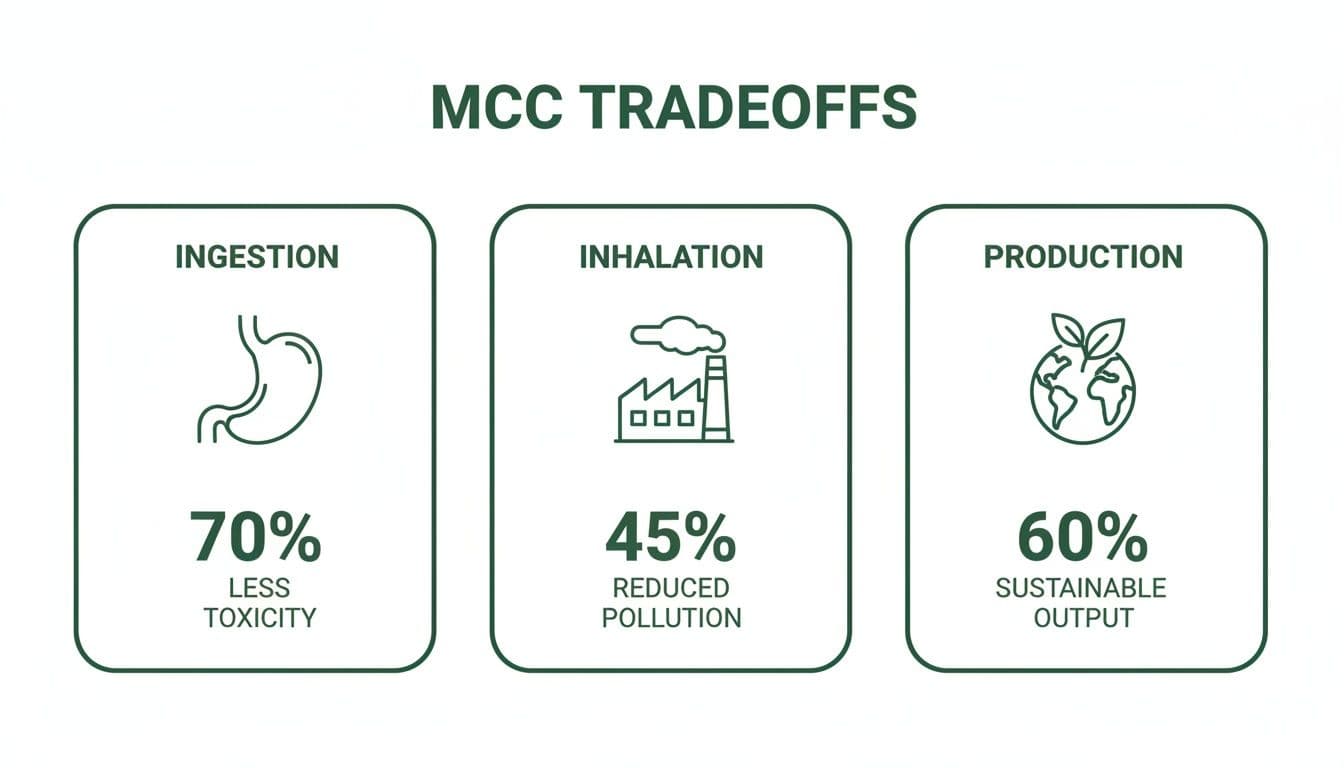
The primary health concerns are not for consumers, but for industrial workers. Like any fine powder, airborne MCC dust can be an irritant if inhaled in large quantities over long periods. Workplace safety agencies have strict exposure limits to protect factory workers. You can see the NIOSH and OSHA exposure limits for cellulose dust to see these occupational standards. This context is entirely different from eating a tablet containing MCC.
Is It Safe During Pregnancy or for Kids?
It's natural to be extra cautious about what touches your skin or what you consume during pregnancy or for your children. The scientific consensus here is reassuring.
Extensive animal studies have found that MCC is not genotoxic (damaging to genes) or teratogenic (causing birth defects). Because it passes through the body without being absorbed, it does not interfere with sensitive biological processes.
Perhaps the strongest evidence is its approved use in the most sensitive products. In the European Union, MCC is permitted in:
- Infant formulas
- Special medical foods
- Foods and supplements for toddlers
Regulators do not take chances with these products. An ingredient must meet an incredibly high safety bar to be approved for infant formula, which speaks volumes about its established safety. If you're curious about plant-based fibers in other areas, like clothing, you might find our guide on regenerated cellulose fiber interesting.
What to Look For
When checking ingredient labels, context matters. Here’s a practical way to think about it.
- Check the "Other Ingredients" list on supplements. If MCC is listed first or second, it's a major component by weight. This is a sign of a product designed for manufacturing efficiency.
- Consider the product type. In a low-fat shredded cheese, MCC is there to prevent clumping. This is a functional use. In a "whole food" vitamin, its presence might contradict the product's marketing.
- Look for alternatives if you prefer. Some brands use other binders like acacia fiber or rice flour, which are less processed. This choice is about formulation philosophy, not a safety risk.
Key Takeaways
- Globally Recognized as Safe: Top health authorities like the FDA and EFSA agree that microcrystalline cellulose is a safe, non-toxic food additive. It holds the highest safety rating possible.
- It's an Inert Fiber: MCC is a purified plant fiber that your body cannot absorb. It passes through your digestive system unchanged, much like the fiber from celery or kale.
- The Real Issue is Processing, Not Peril: The conversation around MCC should not be about danger. It should be about its role as a highly processed, non-nutritive filler in our food supply.
- Context Is Everything: Any potential inhalation risk is confined to industrial workers, not consumers. Its safety for pregnant women and children is well-established.
Limitations and Uncertainty
This analysis is based on decades of public scientific research and regulatory findings.
- Research is always evolving. While the evidence on MCC is consistent and long-standing, our understanding of nutrition could change.
- We did not perform our own lab tests. Our conclusions are drawn from existing studies.
- Individual sensitivity varies. Documented allergies to MCC are virtually unheard of, but unique reactions are always possible.
At Greener Closet, we dig deep into what makes up your clothes, right down to the chemical level, to give you a clear, honest score. We believe you have a right to know what’s in your wardrobe so you can choose products that fit your life and your values.