
What Is Cashmere? Goat Undercoat, How It's Made, and Cashmere vs Wool
Organization-authored. Editorial policy · Report an error
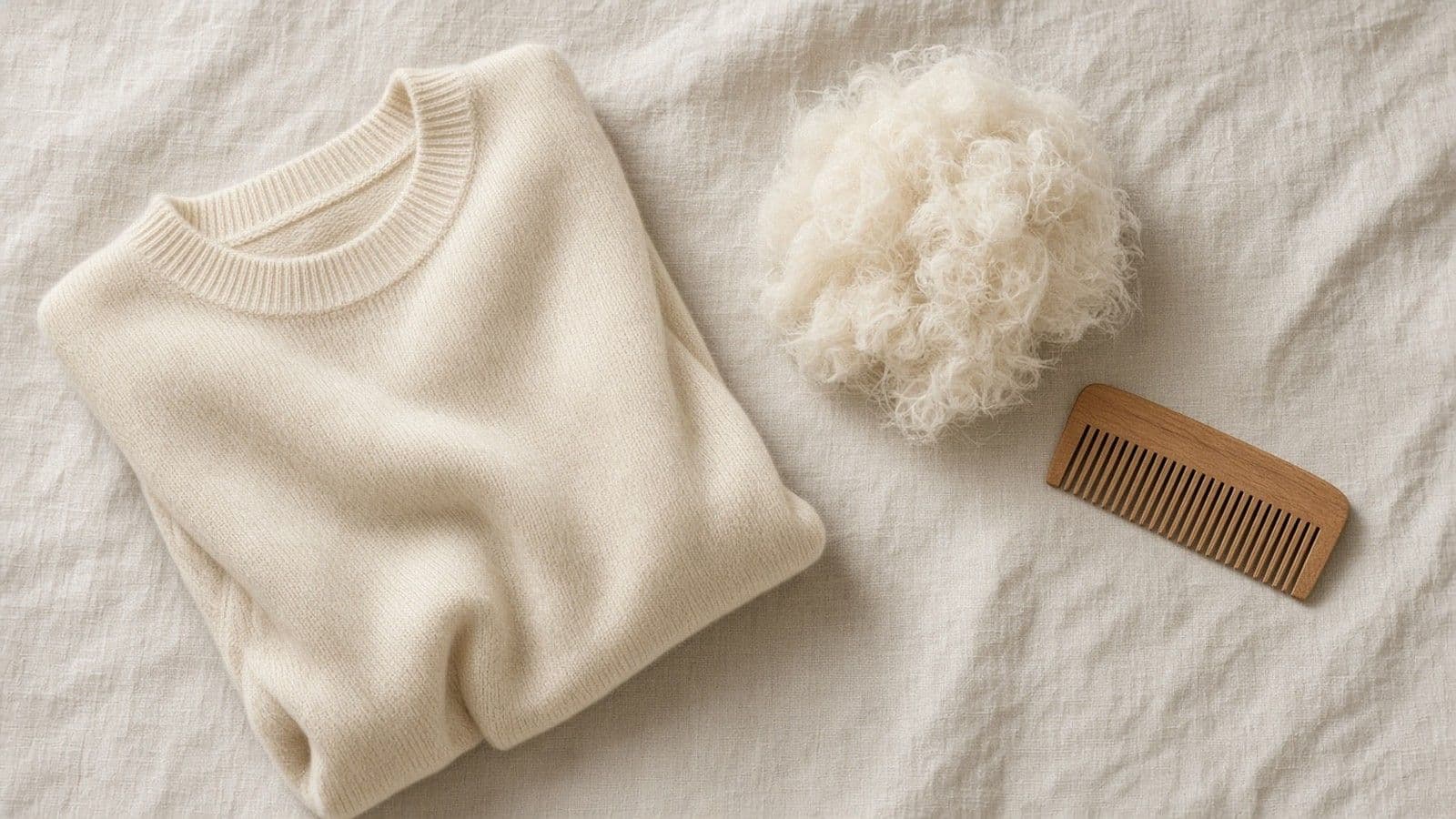
One cashmere goat gives you, on average, only about 0.1 to 0.2 kilograms of underdown a year, according to the Cashmere and Camel Hair Manufacturers Institute. That's a few ounces of soft down, and the coarser outer coat doesn't count.
So when a sweater tag says "100% cashmere," it's pointing at a goat's soft winter undercoat with the guard hair cleaned out, not at sheep wool with a fancy name.
What is cashmere?
Cashmere is the fine, soft undercoat of the cashmere (Kashmir) or down goat, as the CCMI puts it. The straighter, coarser outer coat is called guard hair, and it is not cashmere.
Under US rules, not every fiber from a cashmere goat gets to wear the name. 16 CFR § 300.19, the FTC's Wool Products Labeling rules, says "cashmere" may be used only if:
- The fiber is the fine (dehaired) undercoat of a cashmere goat (Capra hircus laniger).
- The average fiber diameter does not exceed 19 microns.
- No more than 3 percent by weight of the cashmere fibers have average diameters over 30 microns.
The same rule caps the coefficient of variation around that mean diameter at 24 percent. The Wool Products Labeling Act (15 U.S.C. § 68b) uses the same definition. Under that law, a product labeled cashmere that fails any of the three conditions above is misbranded.
What is cashmere made of?
Cashmere is animal hair, and the CCMI groups it with camel hair and sheep wool. What makes it "cashmere" on a US label is which part of which animal it came from, plus that diameter limit.
The goat grows two coats: coarse guard hair on the outside and a soft down underneath that grows for winter. The Sustainable Fibre Alliance describes that undercoat as growing over the whole body except the face and legs, and notes that winters in cashmere regions can drop as low as -40°C.
The CCMI counts five steps from goat to yarn and fabric: collection, sorting and scouring, dehairing, spinning, then weaving or knitting. Fresh off the goat, the fiber still has dirt, grease, vegetable matter, and coarse guard hair mixed in. Dehairing pulls the coarse outer hair out of the fine down, and after that the fiber is ready to spin.
Most of the world's cashmere comes from high plateaus in Asia. China, Mongolia, Afghanistan, and Iran are the big suppliers on CCMI's list, and little comes today from the Kashmir region of India that gave the fiber its name. The Sustainable Fibre Alliance says Mongolia and China together account for roughly 85% of world supply.
How is cashmere made?
Goats shed their undercoat once a year, over a few weeks in spring, and that's when the fiber is collected, either combed out by hand with a coarse comb or sheared off.
An FAO chapter on harvesting textile animal fibers describes how it's done: the goat is tethered, the longer outer hair is clipped first to clear matted hair so combing is easier, and then the undercoat is combed out in short, pulling strokes. The FAO notes combing is more efficient at getting the underwool than shearing, because shearing mixes coarse fiber with the down and can leave some undercoat on the animal. The Sustainable Fibre Alliance makes a similar distinction: in Mongolia, herders often comb by hand and leave guard hair on the goat for protection; in China's Inner Mongolia region, farmers typically use electric shears that take both coats, which the SFA says works there because the goats have shelter.
The yield gap with sheep is big. The CCMI puts a cashmere goat at up to one pound of fiber a year, with an average of 0.1 to 0.2 kg of underdown, while sheep raised for fine and superfine wool yield 2.5 to 4 kg.
Cashmere vs wool: what's actually different?
"Cashmere vs wool" makes them sound like unrelated materials, but US labeling rules let a fiber line say "cashmere" in place of the word "wool" when the fiber meets the definition above. Sheep wool comes from sheep, while cashmere comes from the dehaired undercoat of a cashmere goat, within those micron limits.
Diameter. Cashmere's US ceiling is an average of 19 microns, while sheep wool spans a much wider range. The USDA's wool grades run from finer than grade 80s (an average of 17.69 microns or less) to coarser than grade 36s (40.21 microns or more), so the finest sheep wool is at least as fine as cashmere's cap, while the coarsest is more than twice as thick. Micron alone doesn't tell you which animal it came from, so the legal definition also requires the right species and the dehaired undercoat.
Feel and construction. CCMI describes cashmere's hand as luxuriously soft, with high napability and loft, and sheep wool as soft but also elastic and resilient. The CCMI calls all three, camel hair included, lightweight insulation without bulk. We'd treat blanket "warmer than wool" claims with caution unless a brand shows a real comparison for a specific knit, since the same page notes that wool can be made for any season depending on how the yarn and fabric are built.
What does "cashmere blend" mean on a label?
If the label mentions cashmere, US rules expect percentages. 16 CFR § 300.19 lets "cashmere" stand in for "wool" on the fiber content line only when the cashmere definition is met, and the percentage of that fiber has to be given.
- "100% cashmere" should mean the fiber content is cashmere as defined above. The Wool Products Labeling Act lets the percentages leave out ornamentation up to 5% of the total fiber weight, a bit like the rule our post on what "exclusive of trim" means covers for cotton and other non-wool clothing.
- "Cashmere blend" is useless without percentages. "80% wool, 20% cashmere" and "97% wool, 3% cashmere" are different garments.
- Recycled cashmere has to say so: the rule requires "recycled cashmere" on the label when the fiber is recycled. The CCMI defines recycled as fiber reclaimed from scraps or from fabrics that were previously woven or felted.
- Nylon in the blend. The CCMI notes that blends with nylon, or tri-blends with wool and nylon in woven patterns, may indicate inferior-quality recycled fiber, while also noting nylon is used with virgin cashmere in hosiery and some knits. Read the full fiber line.
CCMI's own advice on pilling is to buy quality garments, which isn't much help from a product photo, but the fiber percentages on the label are something you can check.
How to wash cashmere
Follow the care label first. The CCMI's short version is dry clean wovens, and knits may be hand washed, or machine washed on the special cycles some machines have. Its garment care page fills in the rest for knits: hand wash in cold water with a detergent made for wool, cashmere and silk, never wring or twist it, press the water out with towels, and let it air-dry flat on a dry towel. Woven pieces go to the dry cleaner. Between wears, keep sweaters clean, because dirty ones attract moths, and fold them on a shelf rather than hanging them.
How to check a cashmere piece before you buy
- Read the fiber percentages, not just the product name.
- Remember the US bar: dehaired cashmere goat undercoat, average diameter at or under 19 microns, and the 3% / 30-micron limit.
- Check whether recycled cashmere is disclosed, and whether other fibers are listed with percentages.
- Match the care label to how you actually do laundry.
Greener Closet scores clothing on the fiber content a listing discloses, so if a listing doesn't say what it's made of, we can't fill that in for you.