What "Exclusive of Decoration" and "Exclusive of Trim" Mean on a Label
On a clothing label, "exclusive of decoration" means the fiber percentages cover the main fabric and leave out decoration, like embroidery or a pattern knit in another yarn, that covers no more than 15% of the surface. "Exclusive of trim" means the same for the trim: collars, cuffs, waistbands, labels, structural elastic and sewing thread, which US rules already let brands leave out.
Organization-authored. Editorial policy · Report an error
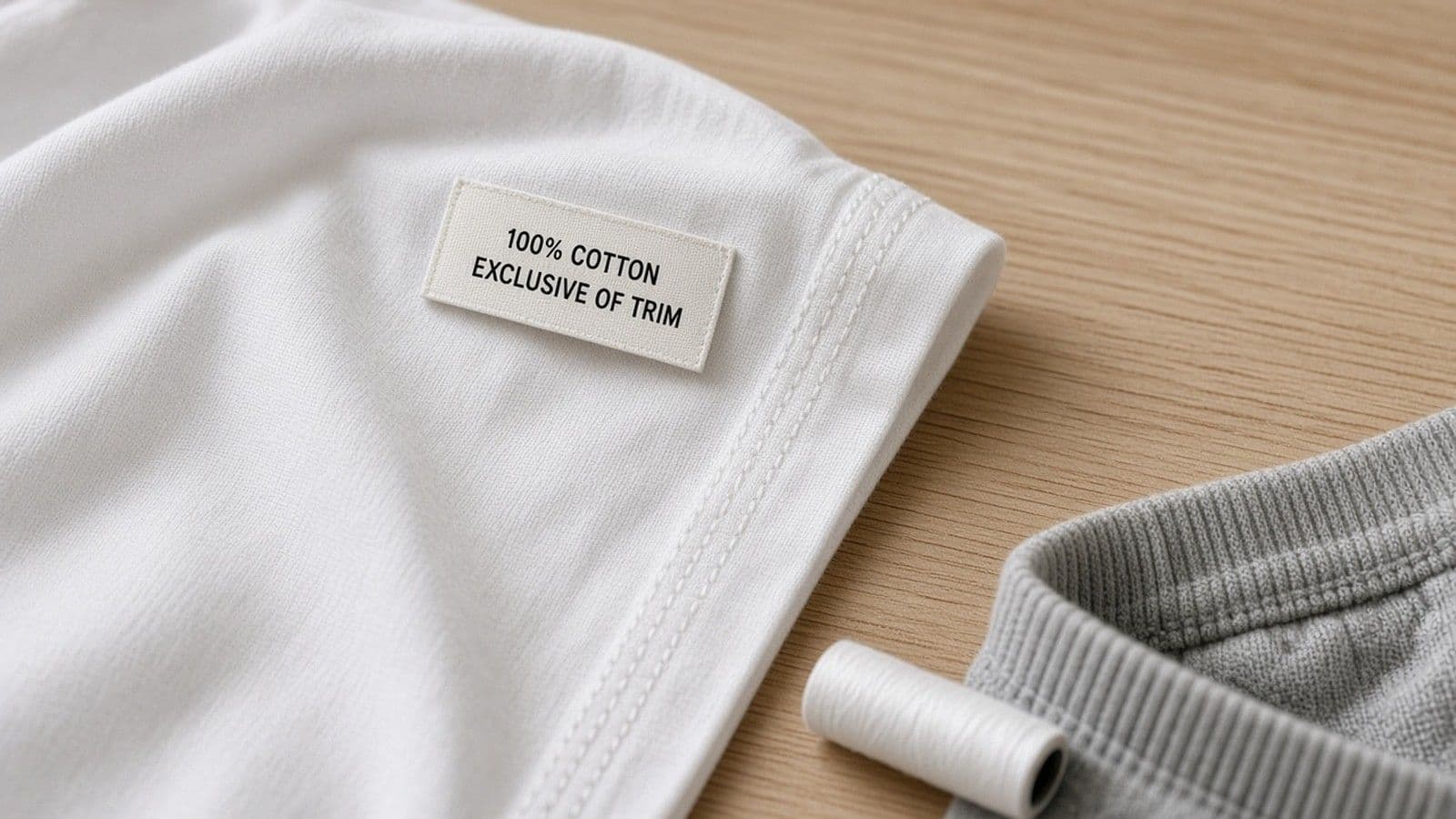
"Exclusive of decoration" comes from the FTC's rules under the Textile Fiber Products Identification Act, 16 CFR Part 303, which also set the limits for "exclusive of elastic" and "exclusive of ornamentation." "Exclusive of trim" isn't in those rules. It's wording brands add on top of the same rules' trim exemption, which lets the label describe the main fabric without counting parts like collars, cuffs, waistbands and thread.
What "exclusive of decoration" means
The trimmings rule, 16 CFR 303.12, treats two things as decoration: decorative trim added by embroidery, overlay, appliqué or attachment, and a decorative pattern or design that's part of the fabric itself. Embroidered flowers on a cotton blouse would count, and so would a stripe knit into a sweater in a different yarn.
If that decoration is a different fiber from the main fabric and covers no more than 15% of the item's surface area, the brand can leave its fiber off the label. The catch is that the fiber content then has to be followed by the words "exclusive of decoration." So "100% cotton, exclusive of decoration" means the body is cotton and the embroidery might not be.
The FTC's guide for sellers, Threading Your Way Through the Labeling Requirements, adds that decoration on collars and cuffs doesn't count toward the 15%, since collars and cuffs are exempt anyway.
Decoration that covers more than 15% of the surface loses the exemption, so its fiber has to go on the label. Smaller decoration has to be disclosed too once the brand says what it's made of. The FTC's example is a cotton tee advertised as a "Silk Trim T." Once the ad says silk, the label has to disclose the silk, for example "Body - 100% Cotton, Decoration - 100% Silk."
What "exclusive of trim" means
"Exclusive of trim" (or "exclusive of trims" or "trimmings") means the percentages describe the main fabric and leave out the garment's trim. Section 303.12 lists what counts as trim, including:
- Rickrack, tape, belting, binding and braid
- Labels
- Collars, cuffs, wrist bands, leg bands and waist bands
- Gussets, gores and welts
- "Elastic materials and threads inserted in or added to the basic product or garment in minor proportion for holding, reinforcing or similar structural purposes"
That last line covers the sewing thread. The FTC's guide says it directly: the threads that hold the garment together don't have to be counted. So a "100% cotton" shirt can be sewn with polyester thread, and the label doesn't have to say so.
The phrase "exclusive of trim" doesn't appear anywhere in the Part 303 rules. They use "exclusive of decoration," "exclusive of elastic" and "exclusive of ornamentation," and each one has a limit. Ordinary trim doesn't need a qualifier at all. Section 303.27 lets a brand say "100%" or "All" when the product is one fiber "other than any fiber ornamentation, decoration, elastic, or trimming as to which fiber content disclosure is not required." So a plain "100% cotton" can already leave the trim out. When a brand adds "exclusive of trim" anyway, it's flagging that some parts may be a different fiber, but it still doesn't tell you which one.
Parts that aren't made of fiber stay off the fiber label too. The FTC guide names zippers, buttons, beads, sequins, leather patches and painted designs, because they aren't made from fiber, yarn or fabric.
Highest-scoring clothes we've scored
See all top-scoring clothes
What "exclusive of ornamentation" means
The rules define ornamentation separately, in 303.1, as fibers or yarns that make a visible pattern or design in a yarn or fabric, like a metallic thread running through a knit. Under 303.26, if that ornamentation is no more than 5% of the product's total fiber weight, the brand can leave it out of the percentages and add "exclusive of ornamentation," as in "All Cotton Exclusive of Ornamentation." Past 5%, it has to be counted in the fiber percentages like everything else.
So decoration is measured by how much of the surface it covers (15%), and ornamentation by how much it weighs (5%).
What "exclusive of elastic" means
Elastic is the part you're most likely to wonder about in underwear, socks and pajama pants. The rules handle it two ways:
- Elastic added in a small amount for structure, like a band sewn into a waistband. That's on the trim list, so it's exempt and the label doesn't have to mention it.
- Elastic that's part of the main fabric. Under 303.12(b), if it covers no more than 20% of the item's surface area, the brand can leave its fiber off, but the label has to add "exclusive of elastic." If it covers more than that, the FTC guide says the elastic gets its own section on the label, starting with the word "Elastic" and followed by its fibers.
Waist bands are on the trim list by name, too, so a pair of "100% cotton" sweatpants can have a waistband in a different fiber and still say 100% cotton. If you want to know what stretchy fibers like spandex are, our post on what elastane is covers it.
The label phrases side by side
| What the label says | What it means |
|---|---|
| "100% cotton" | The main fabric is cotton. Thread, labels, structural elastic and trim like collars, cuffs and waistbands may be another fiber and don't have to be listed. |
| "Exclusive of decoration" | Embroidery, appliqué or a design in the fabric is a different fiber and covers no more than 15% of the surface. Its fiber isn't listed. |
| "Exclusive of ornamentation" | Yarns that make a visible pattern, like a metallic thread, are no more than 5% of the fiber weight. Their fiber isn't listed. |
| "Exclusive of elastic" | Elastic is part of the main fabric and covers no more than 20% of the surface. Its fiber isn't listed. |
| "Exclusive of trim" | Not a phrase the FTC's rules use. The percentages cover the main fabric and leave out trim. |
| "Body: 100% cotton / Rib: 95% cotton, 5% spandex" | A sectional label, with each part listed on its own. This is the most useful kind of label you'll get. |
Linings, tolerances and "other fiber"
Linings. A lining that's only there for structure doesn't have to be disclosed. A lining that's there for warmth does, as its own section, like "Shell: 100% Nylon, Lining: 100% Polyester." The FTC guide also says that if a brand says or implies anything about a structural lining's fiber, the normal disclosure rules apply.
A "100%" label gets no 3% tolerance. For blends, the FTC allows a 3% tolerance, so a label that says 40% cotton can really be anywhere from 37% to 43%. But 303.43(c) says that tolerance doesn't apply when a product is represented as made wholly of one fiber. The FTC guide's example is a blouse that's 97% silk and 3% polyester: it can't be labeled 100% silk, because the polyester was put into the fabric on purpose. The FTC's page on labeling cotton products puts it plainly: a product shouldn't be labeled "100% Cotton" unless it contains only cotton, "or only cotton with some non-cotton 'trim'."
"Other fiber." Under 303.3, a fiber under 5% of the total fiber weight is supposed to be listed as "other fiber" instead of by name, unless it has a clear job at that amount. The FTC's cotton page says fibers with "functional significance, even in small amounts" may be named, and gives "96% Cotton, 4% Spandex" as its example. If you see "other fiber" on something you're trying to keep all natural, the label won't tell you what it is, so ask the brand.
GOTS and OEKO-TEX treat the extras differently
Certifications don't close this gap the way people sometimes expect.
GOTS leaves the extras out of its percentages too. The GOTS standard sets its label grades by certified fiber content "excluding Accessories," and its accessories list includes sewing threads, elastic bands and yarns, labels, trims, buttons and zippers. Accessories can be natural, regenerated or synthetic, as long as they meet the standard's residue limits and aren't on its prohibited list. So a GOTS certified organic cotton bralette with a synthetic elastic band can still meet the standard. We go into this more in our post on GOTS certified brands vs GOTS certified products.
OEKO-TEX STANDARD 100 works the other way. It's a label for textiles tested for harmful substances, not a fiber claim, and OEKO-TEX says every thread, button and accessory on a certified article has been tested. That tells you the extras were part of the testing but not what they're made of.
Quick answers
What does "100% cotton exclusive of decoration" mean? The main fabric is all cotton, and some decoration, like embroidery or a woven-in design, is a different fiber that covers no more than 15% of the surface.
What does "cotton exclusive of trims" mean? The cotton figure covers the main fabric only. Collars, cuffs, waistbands, binding, labels, structural elastic and thread may be another fiber.
Is "exclusive of trimmings" the same as "exclusive of trim"? Yes. The FTC's rule calls these parts "trimmings," and brands use trim, trims and trimmings for the same idea.
What does "exclusive of ornamentation" mean? Decorative yarns that make a visible pattern, like a metallic thread, are left out of the percentages because they're no more than 5% of the fiber weight.
What does "exclusive of elastic" mean? Elastic woven or knit into the main fabric is a different fiber and covers no more than 20% of the surface, so its fiber isn't listed.
Does "100% cotton" include the thread? No. Sewing thread is on the FTC's trim list, so the label doesn't have to say what it's made of.
How to find out what the thread and elastic are made of
The label won't tell you, so the listing or the brand has to. Some listings break the fiber content out by section, like "Body" and "Rib." If the listing doesn't cover it, these are easy questions for a brand to answer:
- What is the sewing thread made of?
- What's in the waistband or any elastic, and does it touch skin or is it covered by fabric?
- Are there parts the fiber content doesn't cover, like linings or trim?
- If it says "other fiber," what is that fiber?
Greener Closet scores clothing from what the listing discloses about fibers and certifications, so we're reading the same label you are. If a listing says "100% cotton," that's what we see, and we can't see the thread or the elastic unless the brand lists them. When you've got a listing or a label in front of you, paste the link or type the label into the fabric checker to see the fiber blend it discloses and how it scores.