100% Wool Coat or Wool Blend? How to Read a Wool Coat Label
"Wool" on a coat label can legally include cashmere and alpaca, but not reclaimed fiber, and the lining doesn't always have to be listed. How to read a 100% wool coat label, plus blends, Super 100's, pilling and care.
Organization-authored. Editorial policy · Report an error
Under US law, the word "wool" on a coat label can cover cashmere, camel hair and alpaca. What it can't cover is wool that was already woven or felted into a product once and then pulled back into loose fiber, because that counts as "recycled wool" (15 U.S.C. § 68).
So a tag that reads "100% wool" is telling you more than it looks like, but it can also leave a few things out, mostly about what's on the inside of the coat. This is how to read a wool coat label before you buy one.
What does "100% wool" mean on a coat?
US wool labels list each fiber by its percentage of the weight. A coat made from one fiber can say "100% Wool" or "All Wool," and the FTC says the usual 3% leeway on fiber percentages doesn't apply when a label says the product is entirely wool (FTC, Threading Your Way Through the Labeling Requirements).
"Wool" in the law means fiber from sheep or lamb fleece, or hair from Angora or Cashmere goats, and it may include camel, alpaca, llama and vicuna. The catch is the last part of the definition: it has to be fiber that "has never been reclaimed from any woven or felted wool product" (15 U.S.C. § 68). Reclaimed fiber is "recycled wool," and a label lists it under that name with its own percentage, like the rule's example "50% Wool 25% Recycled Wool 25% Cotton" (16 CFR Part 300).
Two more terms you'll run into:
- "Virgin wool" or "new wool." Brands can only use these words if the fiber was never reclaimed from any spun, woven, knitted or otherwise made or used product (16 CFR § 300.20).
- "Other fiber." Any fiber under 5% is normally lumped in as "other fiber" instead of being named, but wool is the exception and its percentage always has to be stated. A brand can still name a small fiber when it does a real job, and the rule's own example is "98% wool 2% nylon" (16 CFR Part 300).
Highest-scoring coats and jackets we've scored
See all coats and jackets
Does a wool coat label have to list the lining?
Not always.
For wool garments, the lining's fiber has to be listed when the lining contains wool, when it's there for warmth (coated, laminated, a pile fabric, or anything sold as adding warmth), or when fiber claims are customarily made about that kind of lining. Interlinings, the layer between the outer shell and the inner lining, always have to be listed separately (16 CFR § 300.23).
A lining that has no wool in it and isn't there for warmth can fall outside those rules, so a coat can have a shell that's 100% wool and a lining you know nothing about from the label alone.
If the product page only gives one fiber line, look for a second line on the inside tag, something like "Shell: 100% Wool, Lining: ..." If there's no lining line and the lining matters to you (it's the layer against your sweater and your neck), ask the seller before you buy.
100% wool coat vs wool blend coat
A coat sold as a "wool coat" can still be a blend, and the other fiber might be polyester, polyamide (nylon) or recycled wool. The label tells you exactly how much: a coat that's 60% wool is 40% something else.
We haven't found testing good enough to quote on whether a blend coat is warmer or lasts longer than an all-wool one, so here's what the tag itself gives you:
- The wool share. Wool's percentage is always required, even when it's small.
- What the rest is. Polyester and polyamide are both synthetic, while recycled wool is still wool that's been reclaimed.
- Whether the lining is listed at all. See above.
If you want an all-wool coat, the search that works best is the literal one, "100% wool coat" or "all wool coat," and then check the fiber line on every listing anyway, because "wool coat" in a product title doesn't tell you the percentage.
What does "Super 100's" mean on a wool coat?
It's a fineness grade, and it's regulated. "Super 100's" or "100's" means the wool fiber averages 18.75 microns or finer. "Super 80's" means 19.75 microns or finer, and each step up the scale is half a micron finer, all the way to Super 250's (16 CFR § 300.20a). It's about how fine the fiber is, not how much of the coat is wool, so you still need the percentage line.
Why is my wool coat pilling?
Pilling is caused by rubbing during wear. Woolmark's list of the usual spots, written about sweaters, is the elbows, armpits, sleeves, belly and sides, and it says long stretches of sitting at a desk add to the rubbing. Nobody can promise a wool garment won't pill (Woolmark).
Getting rid of pills:
- Pull them off by hand if there are only a few.
- Use a comb, very gently.
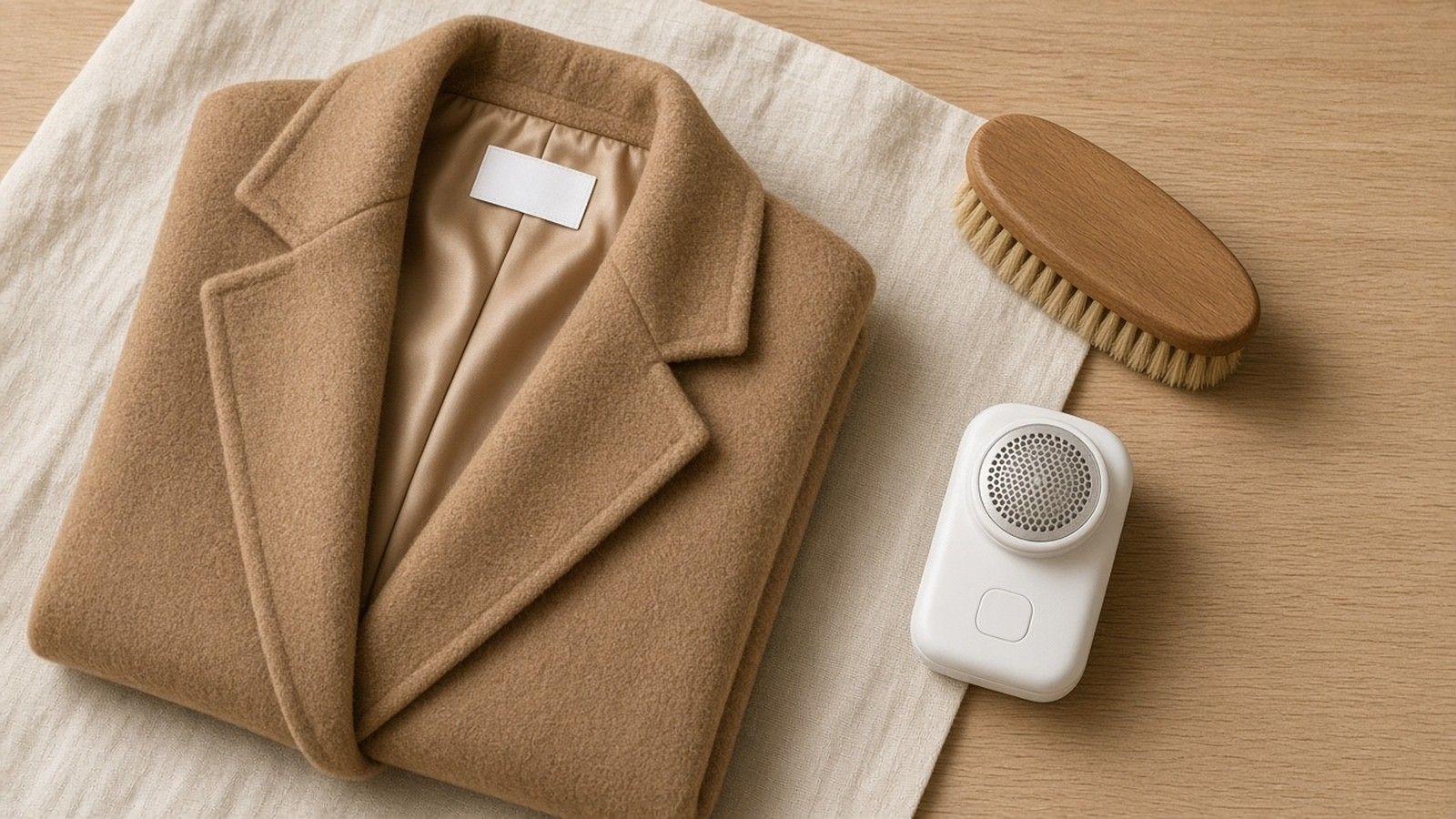
- Use a battery-powered fabric shaver (Woolmark calls these low cost and very effective).
If your coat is washable, turn it inside out before washing it and skip fabric softener, since Woolmark lists both as ways to cut down on pilling (Woolmark).
How to clean a wool coat
A lot of wool coat care happens between washes. The Woolmark Company's care guide boils down to this (Woolmark):
- Brush it after wearing. Use a soft garment brush and go lengthwise. Woolmark says this is for woven garments only, so skip it on a knit coat.
- Air it out. Hang it in fresh air to get rid of food or smoke smells.
- Hang it on a shaped or padded hanger, with the pockets emptied so it doesn't sag and the buttons done up.
- Give it a day off. Let it rest 24 hours between wears so the fiber can spring back.
- Steam out wrinkles by hanging it in a steamy bathroom.
- If it gets wet, dry it at room temperature, away from direct sun and heat.
- Clean it before you store it. Food stains and body oils attract moths.
For actual washing or dry cleaning, follow the care label on the coat.
A quick check before you buy
- Find the fiber line. Is it "wool," "recycled wool" or a blend, and what are the percentages?
- Look for separate lines for the shell, lining and interlining.
- If there's an "exclusive of ornamentation" note, the percentages leave out decorative yarns that make up 5% or less of the fiber weight (16 CFR Part 300).
- If the lining isn't listed, ask.
That fiber line is what Greener Closet reads for you. We score what a listing discloses, so if you're looking at a coat right now, paste its link into our fabric checker and you'll see the fiber blend and a score. If the page leaves out the lining, we can't fill that in either, and that's a fair question to send the seller.
Sources
- 15 U.S.C. § 68: Definitions (Wool Products Labeling Act)
- 16 CFR Part 300: Rules and Regulations Under the Wool Products Labeling Act
- 16 CFR § 300.23: Linings, paddings, stiffening, trimmings and facings
- 16 CFR § 300.20: Use of the terms "virgin" or "new"
- FTC: Threading Your Way Through the Labeling Requirements Under the Textile and Wool Acts (archived)
- Woolmark: What is pilling?
- Woolmark: Caring for wool