
What Is Polyamide? Polyamide vs Nylon, What It's Made Of, and vs Polyester
Organization-authored. Editorial policy · Report an error
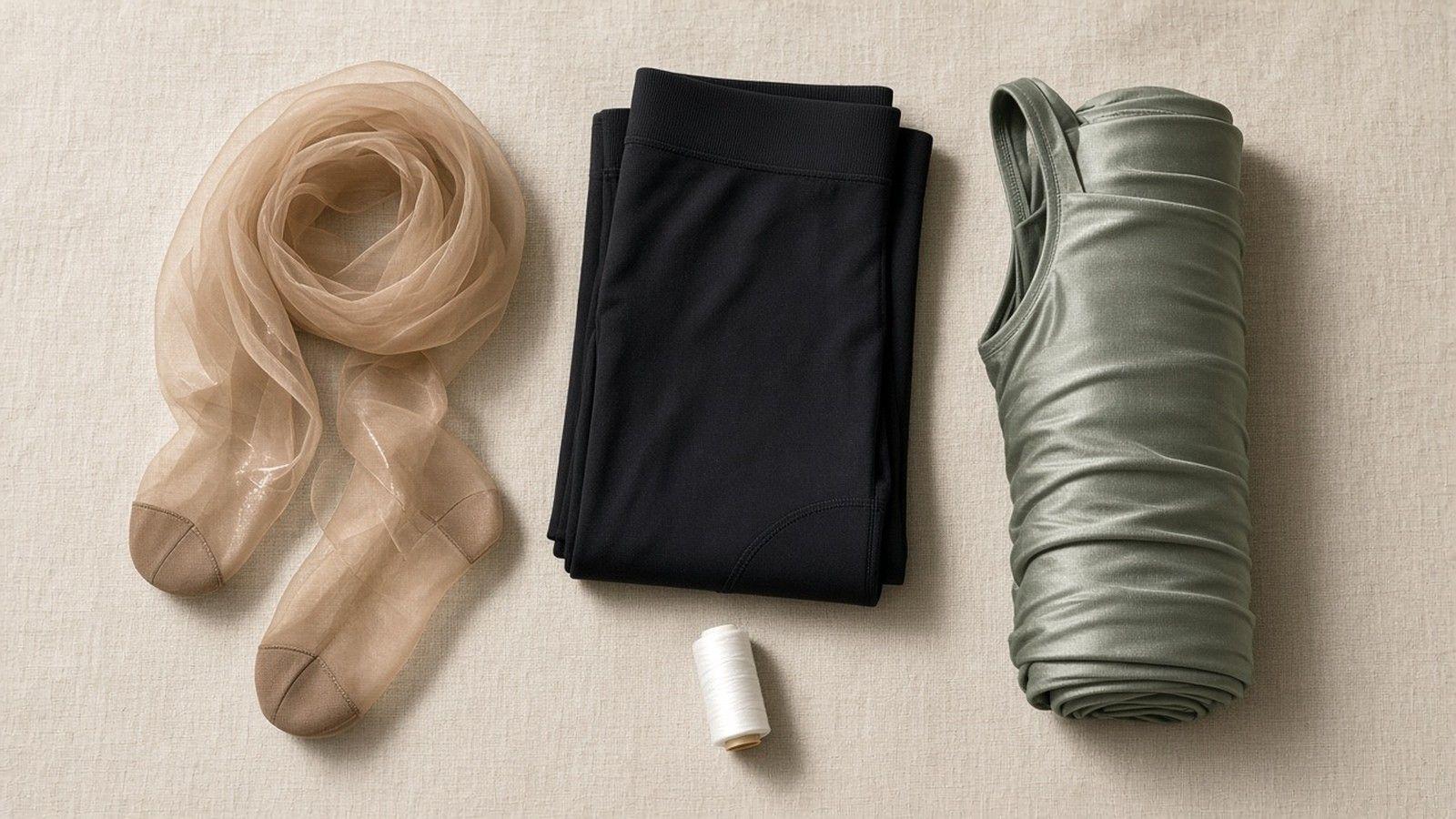
In June 1946, about 40,000 people lined up for more than a mile in Pittsburgh to compete for 13,000 pairs of nylon stockings. Newspapers reported "nylon riots" wherever the stockings showed up after the war, and Pittsburgh's may have been the most extreme (Science History Institute).
That same fiber is probably on a label in your closet right now, under a different name. If your leggings, swimsuit or socks say "polyamide," you're looking at nylon.
What is polyamide?
Polyamide is a polymer, a long chain of repeating units held together by amide links. Chemists use the word for any polymer built that way, and that takes in nylon and Kevlar too (LibreTexts Chemistry).
For clothing labels, the legal definitions do the sorting. The FTC's textile rule defines nylon as "a manufactured fiber in which the fiber-forming substance is a long-chain synthetic polyamide in which less than 85 percent of the amide linkages are attached directly to two aromatic rings." If 85 percent or more of those links attach directly to two aromatic rings, the fiber is aramid instead (16 CFR 303.7). Kevlar is built that way, with its amide links joining benzene rings rather than chains of carbon atoms (LibreTexts Chemistry).
So polyamide fabric, in everyday terms, is nylon fabric.
Polyamide vs nylon: is polyamide nylon?
Yes. On a clothing label, they're two names for the same fiber.
The European Union's list of legal fiber names gives it as "polyamide or nylon," and only names on that list can go on a label there (Regulation (EU) No 1007/2011, Annex I and Article 5, as adopted). The FTC's rule in the US defines essentially the same fiber under the name nylon. So if one sports bra says polyamide and another says nylon, that alone doesn't mean they're made of different fibers.
DuPont, which invented nylon, decided not to trademark the name, hoping shoppers would think of nylon as a generic material, like wood or glass (Science History Institute).
What is polyamide made of?
There are several kinds of nylon, and two you'll see named on fiber charts are nylon 6,6 and nylon 6. The numbers count the carbon atoms in the chemicals each one starts from.
Nylon 6,6 is made from two starting chemicals, adipic acid and hexamethylenediamine, and each has six carbons. They give off water as they link up, and both can be made from cyclohexane (LibreTexts Chemistry). In the 1930s, DuPont's chemical director pushed for 6,6 over another candidate because its ingredients could be made more easily from benzene, and that's the nylon DuPont went on to develop (Science History Institute).
Nylon 6 is made from a single ring-shaped chemical called caprolactam. The ring opens and the pieces join into one long chain (LibreTexts Chemistry).
A clothing label just says nylon or polyamide, so it won't tell you which of the two you have.
Adipic acid has a climate side to it. In a 2009 document, the EPA said 84 percent of the adipic acid made in the US goes into nylon 6,6, and making it releases nitrous oxide, a greenhouse gas, as a by-product. By 1998 all three major US plants had controls in place, and the EPA reported that emissions fell 61 percent from 1990 to 2006 while production rose about 36 percent (EPA technical support document).
How common is polyamide?
It's the second most used synthetic fiber, but it's still a small share of fiber overall. Textile Exchange's 2025 Materials Market Report puts polyamide at about 5% of all fiber made worldwide in 2024, around 7 million tonnes. Polyester was about 59%, roughly 77.7 million tonnes (Textile Exchange).
Nearly all of that polyamide is new fiber made from fossil fuels. The same report says recycled polyamide was only 2% of the polyamide market, mostly made from factory waste or things like old fishing nets and carpets, and biobased polyamide was around 0.4%.
So if a product page says "recycled nylon," it's describing the exception, and it's fair to ask what share of the fabric is recycled and what certification backs that up.
Polyamide vs polyester: what's the difference?
They're both synthetic fibers, and you'll find both in leggings, swimwear and outdoor gear. One technical-textile maker's fiber chart shows where they differ (Atkins & Pearce fiber chart).
Water. Nylon takes up more moisture than polyester. The chart lists moisture regain (how much water a fiber takes up from the air at 70°F and 65% humidity) at 4.5% for nylon 6,6, 2.8 to 5.0% for nylon 6, 0.4% for polyester, and 7.0% for cotton.
Heat. The same chart lists nylon 6 melting at 419 to 430°F, nylon 6,6 at 480 to 500°F, and polyester at 480°F.
Wear. The chart rates both nylon and polyester "excellent" for abrasion resistance. It rates nylon "poor" against acids, and acid really does damage it. Strong acids break nylon's amide links, so a spill of something like dilute sulfuric acid can leave a hole (LibreTexts Chemistry).
How common. Polyester is made in roughly eleven times the volume of polyamide, going by the Textile Exchange numbers above.
Is polyamide breathable?
The fiber chart can't fully answer that. By how much moisture the fiber takes up from the air, nylon sits between polyester and cotton, but that's a number for the fiber, and it doesn't measure how much air gets through a finished fabric.
What the fiber name leaves out
"80% polyamide, 20% elastane" tells you which fibers the yarn is made of, but it doesn't tell you what dyes were used or whether a finish was added, like a water repellent or an anti-odor treatment. Our nylon material guide covers how a plain nylon label scores.
Two questions we'd ask about a nylon piece you wear a lot, especially against skin or on a kid:
- Does it have a water-repellent or stain-resistant finish? That's where PFAS questions usually come up. We walk through how to check in our guide to avoiding PFAS in clothing.
- Is there a third-party certification for the finished product? A certification on the finished garment covers more than a claim about the fiber does. Our post on GOTS-certified brands vs certified products shows how to tell which one you're looking at, and it covers OEKO-TEX too.
Like polyester, nylon is a synthetic that can shed fibers in the wash. If that's your concern, see microplastics from clothing.
What to look for on a polyamide label
Start with the fiber line. "Polyamide" and "nylon" mean the same thing, so don't let the word change how you compare two items. Then check whether it's blended with elastane, and how much. If the listing says recycled, look for how much is recycled and who certified it. And if it says water-resistant or stain-resistant, that's the part to ask the brand about, since the fiber name won't tell you.
This is the kind of thing we built Greener Closet's scoring to help with while you browse. We can only score what the listing discloses, though. If a brand doesn't say what finish is on a pair of leggings, we can't fill that in for you.