
Original catalog research
How much clothing is synthetic? What 3,454 listings say
Snapshot taken November 26, 2026 · Greener Closet editorial review
We added up the fiber content of 3,454 clothing listings from 697 brands in the Greener Closet catalog. 57% list at least some synthetic fiber, and 26% are half synthetic or more. Swimwear, activewear and leggings have the highest shares of mostly synthetic listings. Denim, babywearing, pajamas and shirts have the lowest. The figures come from retailer listings.
What we found
- The average listing is 30% synthetic by weight, 62% natural fiber and 9% cellulose fibers like viscose and lyocell. 43% of listings have no synthetic fiber at all.
- In natural-fiber clothes, the synthetic is often just stretch. 43% of listings contain elastane (spandex), usually a little: the median is 6% of the fabric. Of the 2,585 listings that are mostly natural or cellulose fiber, 43% still contain some synthetic, and for 50% of those the only synthetic is elastane.
- Swimwear (82%), activewear (67%) and leggings (57%) are mostly synthetic more often than not. None of the 127 denim listings was mostly synthetic. The share was 8% for shirts and 7% for pajamas.
- Socks almost always have some synthetic (91%), but only 19% are mostly synthetic. Elastane appears in 88% of sock listings. In listings that contain it, the median share is 3% of the fabric.
- 39% of the synthetic fiber is recycled, by weight. Coats and jackets are highest at 71%, while socks are at 5% even though nearly all of them contain synthetic. Recycled polyester and nylon are still synthetic.
- Women's listings average 37% synthetic against 24% for men's. Activewear, leggings, bras and swimwear account for 25% of women's listings and 7% of men's. The averages reflect each department's mix of categories.
For scale, synthetic fibers made up 69% of all the fiber produced worldwide in 2024, according to Textile Exchange's Materials Market Report 2025 (summary on the EU Textiles Ecosystem Platform). That figure is tonnes of fiber made, not a count of clothing listings, so the two numbers measure different things.
Mostly synthetic, by category
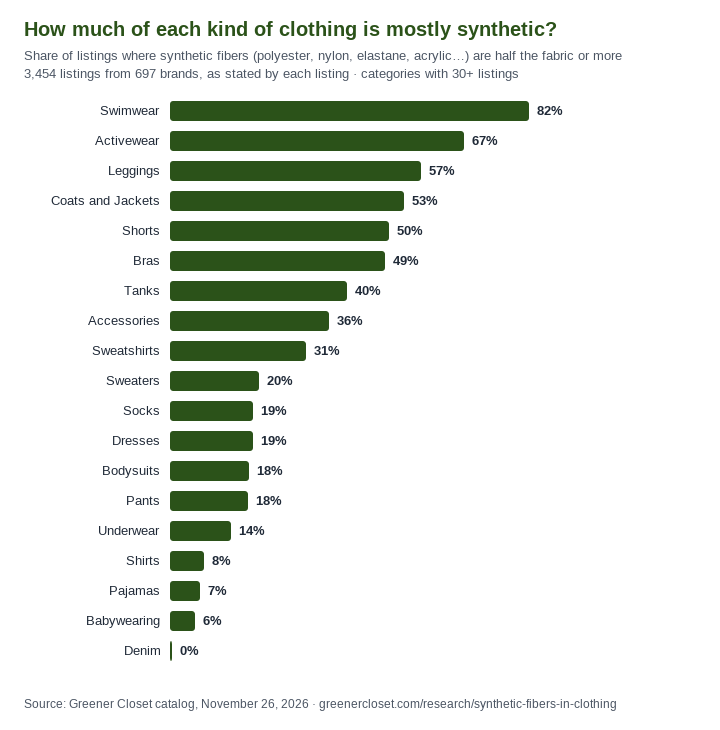
Every category
| Category | Listings | Any synthetic | Mostly synthetic | Average synthetic share | With elastane | Synthetic that is recycled |
|---|---|---|---|---|---|---|
| Swimwear | 38 | 87% | 82% | 82% | 79% | 56% |
| Activewear | 292 | 88% | 67% | 68% | 80% | 38% |
| Leggings | 207 | 88% | 57% | 60% | 88% | 38% |
| Coats and Jackets | 226 | 66% | 53% | 55% | 17% | 71% |
| Shorts | 263 | 69% | 50% | 52% | 59% | 46% |
| Bras | 141 | 92% | 49% | 55% | 91% | 38% |
| Tanks | 132 | 71% | 40% | 43% | 62% | 27% |
| Accessories | 36 | 39% | 36% | 35% | 11% | 34% |
| Sweatshirts | 246 | 67% | 31% | 38% | 20% | 60% |
| Sweaters | 218 | 39% | 20% | 24% | 9% | 47% |
| Socks | 227 | 91% | 19% | 31% | 88% | 5% |
| Dresses | 95 | 54% | 19% | 24% | 37% | 21% |
| Bodysuits | 61 | 43% | 18% | 21% | 38% | 11% |
| Pants | 474 | 53% | 18% | 22% | 37% | 46% |
| Underwear | 309 | 75% | 14% | 20% | 74% | 11% |
| Shirts | 538 | 30% | 8% | 11% | 20% | 39% |
| Pajamas | 205 | 30% | 7% | 9% | 21% | 8% |
| Babywearing | 35 | 20% | 6% | 6% | 20% | 0% |
| Denim | 127 | 37% | 0% | 3% | 37% | 0% |
By department
| Department | Listings | Any synthetic | Mostly synthetic | Average synthetic share | Activewear, leggings, bras or swimwear |
|---|---|---|---|---|---|
| Women's | 1,868 | 66% | 33% | 37% | 25% |
| Men's | 1,066 | 50% | 20% | 24% | 7% |
| Unisex | 190 | 39% | 14% | 16% | 1% |
| Kids | 84 | 36% | 10% | 14% | 10% |
| Baby | 246 | 44% | 9% | 14% | 5% |
The most common fibers
| Fiber | Listings that contain it | Average share of the fabric |
|---|---|---|
| Cotton (any kind) | 54% | 46% |
| Elastane / spandex | 43% | 4% |
| Polyester | 27% | 16% |
| Nylon | 18% | 9% |
| Viscose, modal, lyocell and other cellulose fibers | 14% | 9% |
| Wool and hair fibers | 11% | 8% |
| Linen and hemp | 7% | 5% |
| Silk | 2% | 2% |
| Acrylic | 1% | 1% |
| Other | 1% | 0% |
Use the chart or the numbers
You're welcome to republish the chart or any number on this page. Please credit Greener Closet and link to this page, so readers can see the method and limits below. To put the chart on your site, copy this:
<a href="https://greenercloset.com/research/synthetic-fibers-in-clothing"><img src="https://greenercloset.com/research/fiber-mix-2026-11-26.svg" alt="Share of clothing listings that are mostly synthetic, by category (Greener Closet, November 2026)" width="720"></a>The chart is a plain image file at https://greenercloset.com/research/fiber-mix-2026-11-26.svg. The CSV contains fiber-mix summaries for the full sample, each category and each department. If you need a figure we haven't published, like one category in one department, ask us.
Method, scope and limits
This sample comes from the Greener Closet catalog. We add products when someone checks a product link or when our daily catalog job adds listings, mostly from stores and categories people check. The most common material is organic cotton (913 listings), and the ten biggest brands make up 29% of the listings. Those choices limit how far the results can tell us about other stores.
What we counted. The 3,633 products visible in the catalog on November 26, 2026, minus 179 home textiles like sheets and towels, leaves 3,454 clothing listings (3,447 distinct product names; colors are rarely listed twice). They were added between June 2024 and November 2026, and 84% had their materials matched against the live listing in the 90 days before the snapshot.
How we counted. Each share is by weight, as the listing states it, rescaled to 100 where the stated numbers didn't add up (1 listing). Where a listing states a full-body lining, the lining counts as 30% of the garment (53 listings). "Mostly synthetic" means synthetic fibers are half the fabric or more. Each category and department needs at least 30 listings to be shown.
What counts as synthetic. Fibers made from plastic polymers: polyester, nylon, elastane, acrylic, polyurethane and their recycled and bio-based versions. Viscose, modal, lyocell, cupro and acetate are made from wood pulp or other cellulose, so we count them as their own group. Natural fibers are plant and animal fibers like cotton, linen, hemp, wool, silk and down. The full list is below.
What this can't tell you. We didn't test any garments, and we didn't check sewn-in labels, trims or every color. A fiber label says nothing about dyes, finishes, coatings or PFAS, so none of these numbers are about chemical safety. See the scoring methodology and its limits, the leggings disclosure review for how listings and our records can differ, and the fabric checker to read a label yourself.
To report a mistake, contact Greener Closet. This snapshot won't change; a later one will get its own date and files.
Every material name and how we grouped it (66)
- Organic Cotton: natural, 913 listings
- Elastane: synthetic, 908 listings
- Cotton: natural, 813 listings
- Spandex: synthetic, 478 listings
- Recycled Polyester: synthetic (recycled), 476 listings
- Polyester: synthetic, 455 listings
- Nylon: synthetic, 394 listings
- Merino Wool: natural, 183 listings
- Viscose: cellulose, 145 listings
- Linen: natural, 138 listings
- Tencel Lyocell: cellulose, 120 listings
- Recycled Nylon: synthetic (recycled), 106 listings
- Polyamide: synthetic, 104 listings
- Wool: natural, 99 listings
- Lycra: synthetic, 77 listings
- Hemp: natural, 76 listings
- Supima Cotton: natural, 74 listings
- Silk: natural, 67 listings
- Cashmere: natural, 66 listings
- Tencel Modal: cellulose, 63 listings
- Modal: cellulose, 53 listings
- Acrylic: synthetic, 49 listings
- Lyocell: cellulose, 39 listings
- Bamboo Viscose: cellulose, 37 listings
- Regenerative Organic Cotton: natural, 29 listings
- Recycled Cotton: natural, 27 listings
- Rayon: cellulose, 22 listings
- Egyptian Cotton: natural, 20 listings
- ECOVero Viscose: cellulose, 19 listings
- Alpaca: natural, 17 listings
- Elastomultiester: synthetic, 16 listings
- Regenerative Cotton: natural, 13 listings
- Roica V550: synthetic, 11 listings
- Recycled Wool: natural, 10 listings
- Organic Linen: natural, 9 listings
- Polyurethane: synthetic, 8 listings
- Leather: natural, 7 listings
- Ciclo Nylon: synthetic, 6 listings
- Bamboo: cellulose, 5 listings
- Goose Down: natural, 5 listings
- Goose Feathers: natural, 5 listings
- Seacell: cellulose, 5 listings
- ECONYL: synthetic (recycled), 4 listings
- Natural Rubber: natural, 4 listings
- Recycled Spandex: synthetic (recycled), 4 listings
- Tanboocel: cellulose, 4 listings
- EVA: synthetic, 3 listings
- Kapok: natural, 3 listings
- Roica EF385: synthetic (recycled), 3 listings
- Bio-based Nylon: synthetic, 2 listings
- Livaeco Viscose: cellulose, 2 listings
- Recycled Elastane: synthetic (recycled), 2 listings
- Acetate: cellulose, 1 listings
- Bamboo Rayon: cellulose, 1 listings
- Bio-based Creora: synthetic, 1 listings
- Bio-based Elastane: synthetic, 1 listings
- Biodegradable Nylon: synthetic, 1 listings
- Cupro: cellulose, 1 listings
- NAIA Renew: cellulose, 1 listings
- Organic Cashmere: natural, 1 listings
- Recycled Cashmere: natural, 1 listings
- Recycled Down: natural, 1 listings
- Recycled Elastomultiester: synthetic (recycled), 1 listings
- Sorona: synthetic, 1 listings
- Thermolite: synthetic (recycled), 1 listings
- Unspecified Synthetic: synthetic, 1 listings