
How Is Silk Made? What Silk Is Made Of, Mulberry Silk, and Silk vs Satin
Organization-authored. Editorial policy · Report an error
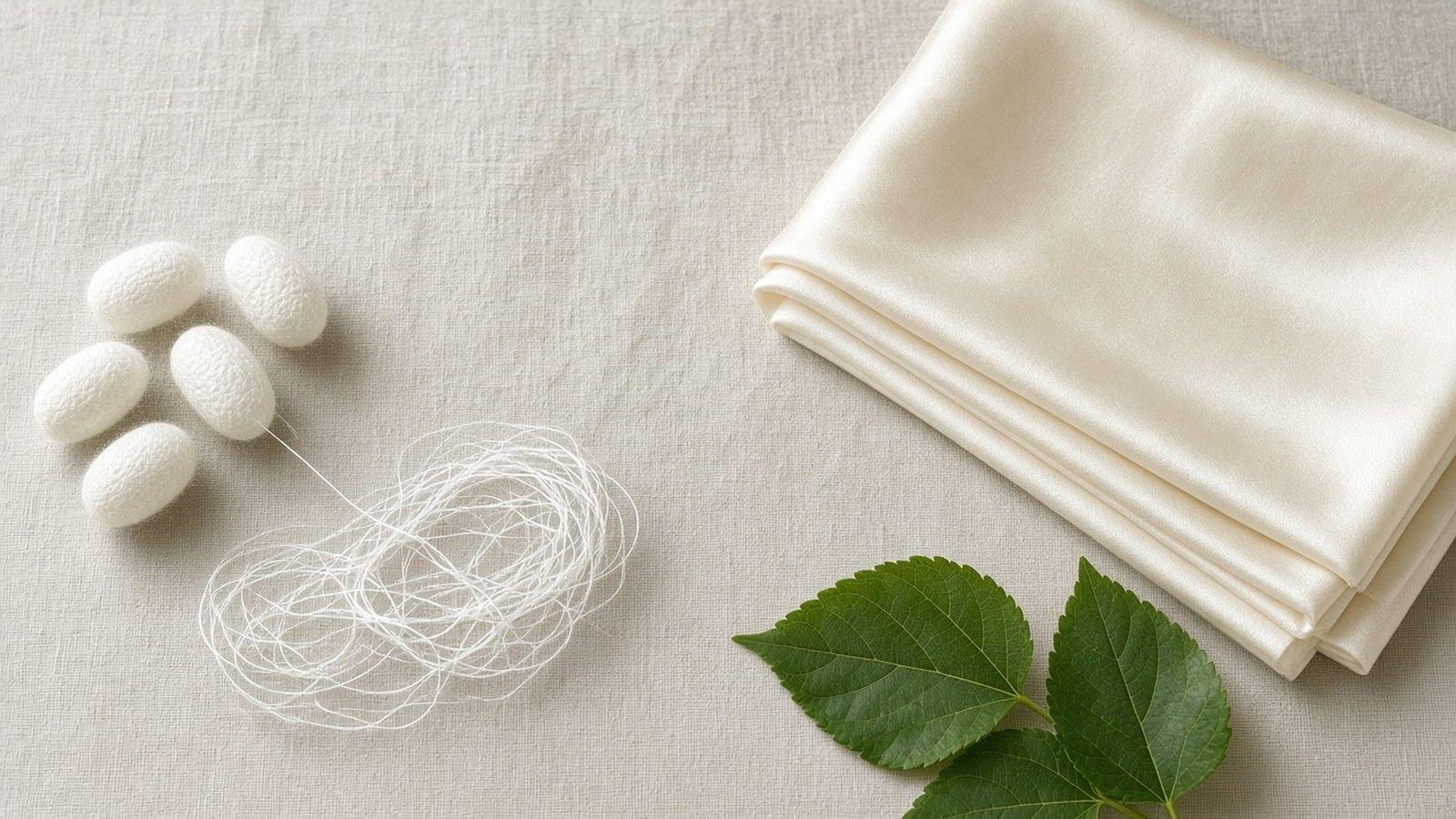
A mulberry silkworm spins its cocoon from one continuous strand about the length of twelve football fields, pushing silk out at about a foot a minute for three days, according to Karen Selk's Spin-Off article "Peace Silk—what does it really mean?". That one long strand is the reason silk is made the way it is, and it's also why, for the shiniest kind of silk, the pupa inside is killed before it can turn into a moth.
What is silk made of?
Silk is a protein fiber made by an animal, and it's built from two proteins, fibroin and sericin. A 2023 study in Scientific Reports on degumming silk cocoons describes the two like this:
- Fibroin is the fiber itself. It doesn't dissolve in water, and it's what's left in the degummed filaments that get made into cloth.
- Sericin, also called gum, is a glue-like protein that coats the fibroin and binds the filaments into a cocoon. It usually makes up about 20 to 30 percent of the cocoon shell in commercial Bombyx mori varieties.
So raw silk straight off the cocoon is partly glue, and getting it off is called degumming. We'll get to that below.
The same study calls Bombyx mori, the mulberry silk moth, the most important producer of silk, and Selk writes that it has been cultivated for over five thousand years.
How is silk made?
Raising silkworms is called sericulture. Here's how reeled silk gets from egg to fabric, following Selk's article unless we say otherwise.
- Feeding. The caterpillars hatch from eggs and eat nearly nonstop, increasing their body weight ten thousand times over a lifespan of about thirty days. Bombyx mori eat only mulberry leaves.
- Spinning the cocoon. The caterpillar pushes out semiliquid fibroin coated in sericin. The strand hardens in the air, and the caterpillar keeps spinning for about three days until the cocoon is done.
- Stifling. A moth that comes out on its own releases an enzyme-rich juice that loosens the filament, and the strands it touches turn weak and are more likely to break during reeling. So to keep the longest strand, the pupa is killed inside the cocoon very quickly with dry heat. The pupa doesn't go to waste, though, since it's a source of protein for people and their animals.
- Softening and reeling. The cocoons are soaked in warm water to soften the sericin. One cocoon's strand is too fine to use alone, so filaments from six to twenty cocoons are reeled together, and as the sericin dries it binds them into one thread about the size of a human hair.
- Degumming. The sericin gets removed. The Scientific Reports study says the usual methods use soap, alkalis, organic acids, enzymes or detergents, and in its lab tests, fully degumming Bombyx mori cocoons took about 30 to 35 percent off their weight. That count includes the sericin plus wax, pigments, sugars and other impurities.
- Dyeing and weaving. The yarn gets dyed and woven into cloth.
Silk made this way is called reeled or filament silk, and Selk calls it the highest-quality yarn, and a very shiny one.
What about spun silk?
Not every cocoon can be reeled. Spun silk is made from the weak filament of the see-through layer left over from reeling, from damaged, discolored or misshapen cocoons, and from cocoons the moths have already left. That waste is degummed with soap and water, cut into even lengths, carded and combed, then spun into yarn that's lustrous but not as shiny as reeled silk.
What does "mulberry silk" mean?
Mulberry silk is silk from Bombyx mori. Its caterpillars eat mulberry leaves exclusively, so the name tracks their food. Selk describes the silk as white and shiny and names China as the largest producer.
On a label, "100% mulberry silk" tells you which silkworm the silk came from. It doesn't tell you the weave, the weight, or how the fabric was dyed or finished.
Other silks come from other moths. Selk's article covers tussah (also called tasar), whose tan to gray cocoons come from semi-wild caterpillars that feed in trees in India, and muga, whose golden cocoons come from Assam and nearby states in northeastern India. There's also eri, whose caterpillars eat castor leaves and whose tangled cocoons can only be spun.
What is peace silk (ahimsa silk)?
Peace silk means the moth is allowed to come out of the cocoon on its own before the cocoon is used, and Selk calls that the only true peace silk. Wild silks are often mistakenly called peace silk, she writes, but tussah and muga are reeled too, which means the pupa is killed, and eri pupae are almost always taken out to feed people or other animals.
Selk says there's no way to reel silk and let the moth come out naturally, so peace silk from cocoons the moths have left is spun instead of reeled. Wikipedia's ahimsa silk entry says peace silk takes 10 extra days, and that once the moth has broken the fibers, a cocoon yields one-sixth of the usable filament, which it says pushes the price to about twice that of regular silk. The same entry says "ahimsa" is Sanskrit for nonviolence, and Selk writes that the term "ahimsa silk" was patented in 2006 as a method of making mulberry silk yarn that's only spun, never reeled, because of the hole in the cocoon.
Selk writes that "taken strictly, there is no such thing as vegan silk," since silk is produced by an animal. And the Wikipedia entry describes an investigation by Beauty Without Cruelty in India, which said the mating moths were killed in at least one facility. Making sure peace silk is what it's advertised to be takes some research, so it's fair to ask the brand who made the yarn and how.
Silk vs satin: what's the difference?
Silk is a fiber, and satin is a weave. Wikipedia's satin entry describes it as a weaving technique where yarns float over other yarns, and says a satin weave made with filament fibers like silk, polyester or nylon is called satin, though some definitions insist satin is only silk. Satin started in ancient China as a silk-only fabric, and the same weave made with short-staple yarn like cotton is called sateen.
So a satin pillowcase could be silk, but it could also be polyester, and the word "satin" alone won't tell you which. Our silk material guide puts it the same way: satin isn't proof of silk content.
How to tell what you're actually buying
In the US, the FTC's textile rules say that, with a few exceptions, every fiber that makes up 5 percent or more of a product's fiber weight has to be named by its generic name, and "silk" is one of the names given as an example (16 CFR 303.6).
When we're looking at a silk listing, this is what we look for:
- The fiber line, not the product name. "Satin slip" or "silky blouse" in the title tells you nothing about the fiber. Look for "100% silk" or "100% mulberry silk" in the fiber content, and know that even "100%" can leave out trims like waistbands, cuffs and labels, which our guide to "exclusive of trim" walks through.
- Blends. If it says something like "silk blend," look for each fiber that makes up 5 percent or more to be named. If they aren't there, ask.
- Satin with no fiber listed. Treat the fiber as unknown until the listing says otherwise. It could be silk, polyester or nylon.
- "Peace silk" or "ahimsa silk." Ask the brand who made the yarn and whether the moths came out on their own.
Greener Closet scores what a listing actually discloses, so if a brand doesn't list the fiber content, we can't fill it in for them. That's the moment to email the brand before you buy.