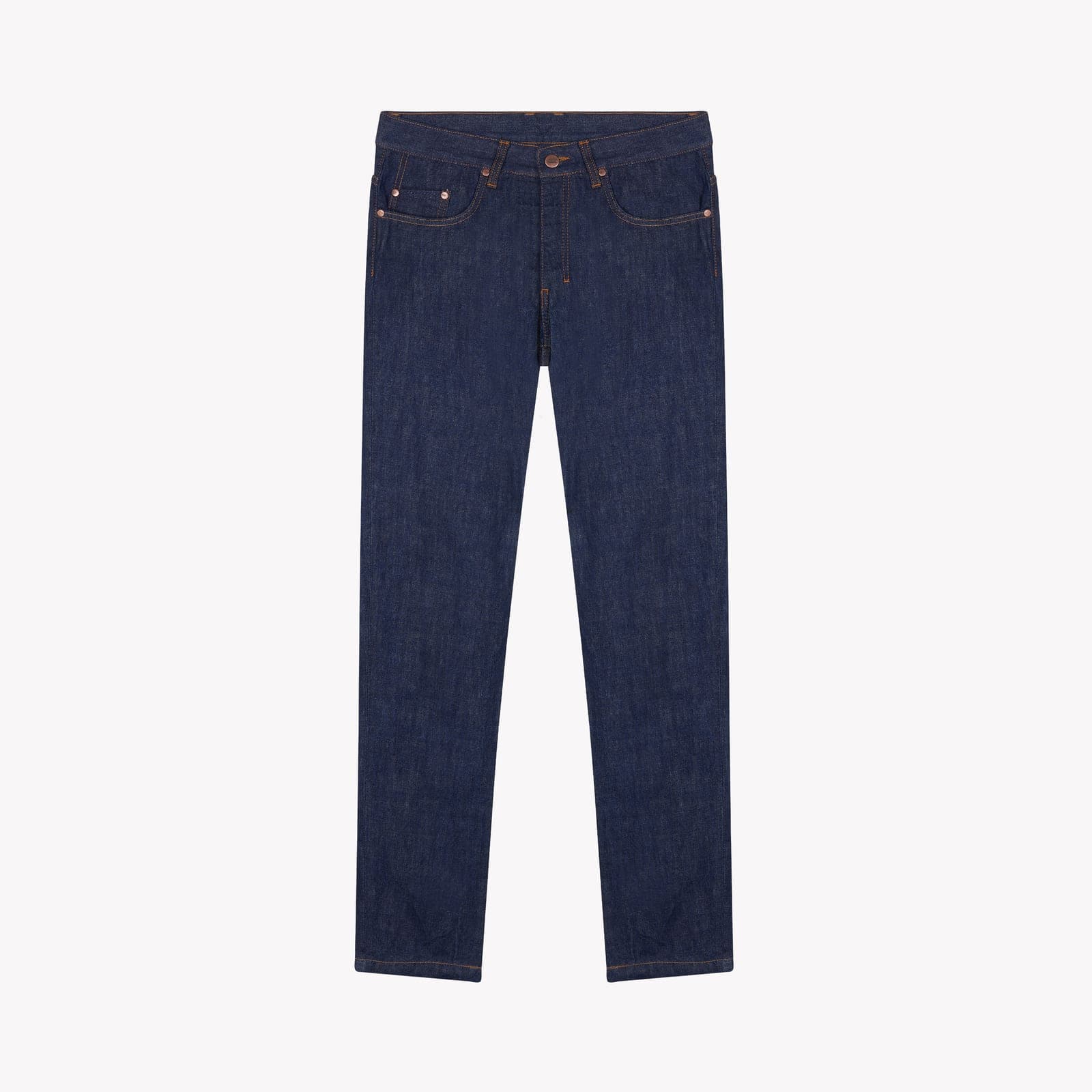
What Is Denim Made Of? Cotton Twill, Stretch, Raw and Selvedge Denim
Denim is usually a cotton twill with indigo-dyed warp threads. What denim is made of, how to tell if your jeans are all cotton, what stretch, raw and selvedge denim mean, and how often to wash jeans.
Organization-authored. Editorial policy · Report an error
In 2020, a team at the University of Toronto published a study in Environmental Science & Technology Letters on the tiny fibers sitting in lake and ocean sediment, from the Great Lakes and shallow suburban lakes in southern Ontario all the way up to the Canadian Arctic. Somewhere between 12 and 23 percent of all the microfibers they analyzed were indigo denim fibers, and when they washed used jeans, they found one pair can release about 56,000 microfibers per wash.
Those denim fibers were cellulose, the stuff cotton is made of, and not plastic, which tells you a lot about what denim is, so it's a good place to start.
What is denim made of?
Denim is usually made of cotton. It's a sturdy cotton fabric woven in a twill, with dyed threads running one direction and white threads running the other.
Wikipedia's denim entry calls it "a sturdy, cotton, warp-faced textile," and says traditional denim yarn is made entirely of cotton.
So the honest answer to "what is denim made of" is cotton, most of the time. Some jeans add a stretch fiber or something else to the cotton, though, and the label is the only way to know which one you're holding.
What is denim, exactly?
What makes denim denim is how it's woven and dyed, as much as the cotton in it.
The weave. Denim is a twill. According to Wikipedia, the weft (the crosswise thread) passes under two or more warp threads, which makes the diagonal ribbing you can see if you look closely at a pair of jeans. Because the blue warp threads dominate one face of the fabric and the white weft dominates the other, jeans are mostly white on the inside. Turn a pair inside out and you'll see it.
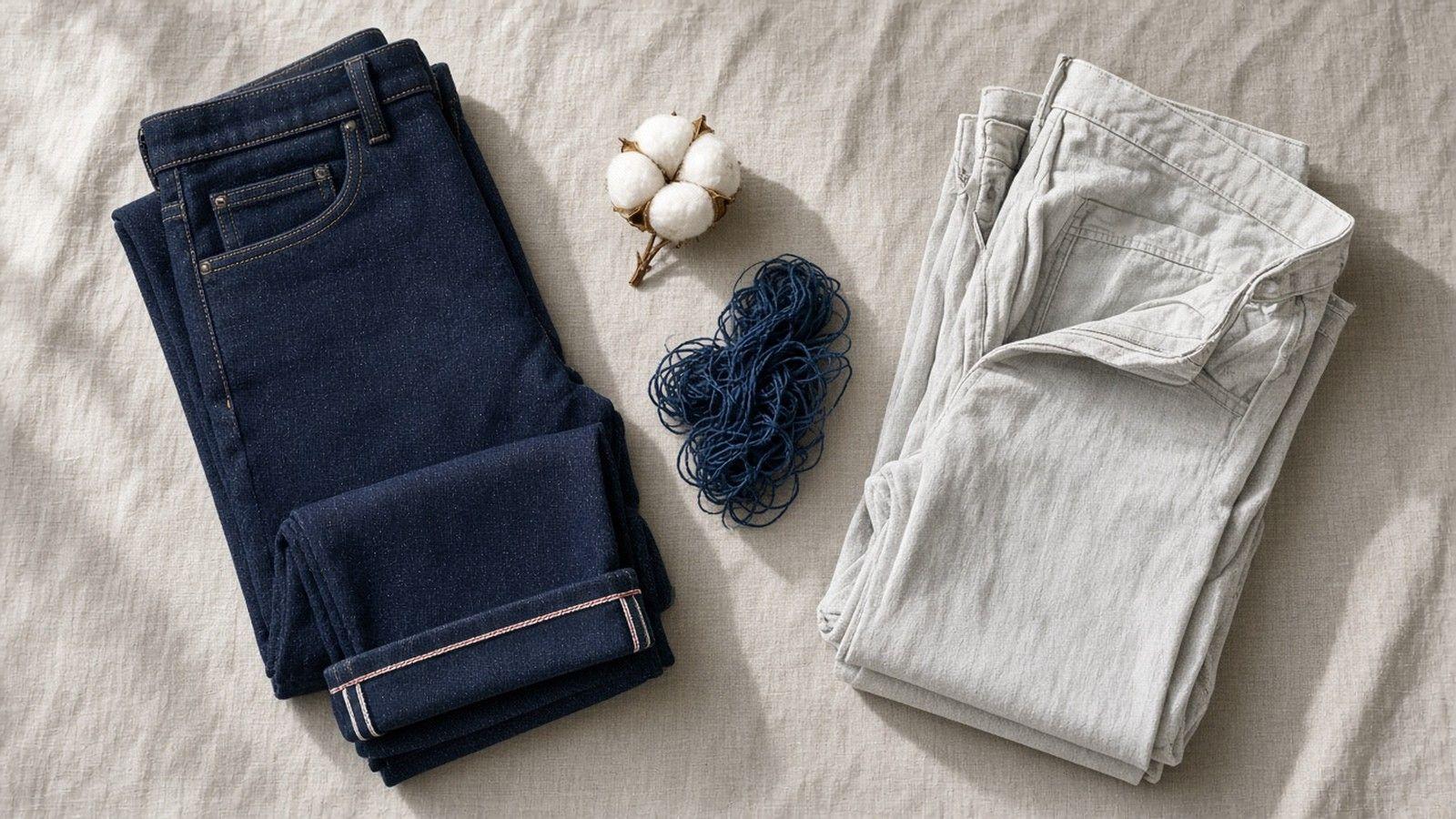
The dye. Classic blue denim is dyed with indigo. Wikipedia says denim was originally dyed with indigo extracted from plants, often from the genus Indigofera, but most denim today is dyed with synthetic indigo. The yarn gets dipped and exposed to air over and over, and more dips give a darker blue.
Indigo also behaves differently from a lot of dyes. It mostly sits on the outer surface of the cotton yarn instead of soaking all the way through, which leaves a lighter core. That's called ring dyeing, and as the outer layer wears away, the lighter cotton underneath shows through, which is why jeans fade most at the knees, seams and pockets. Black and some other colors of denim are made with sulfur dyes instead.
The name. Wikipedia says "denim" started as a contraction of the French sergé de Nîmes, meaning serge from Nîmes, the city in France. Jeans themselves date to May 20, 1873, when Jacob Davis and Levi Strauss received US patent 139,121 for putting metal rivets in work pants (Levi Strauss & Co.).
Is denim cotton?
Usually, yes, but not always. Some jeans have a small amount of stretch fiber added, and the fiber label is where anything else in the blend shows up.
In the US, the FTC's labeling rules mean you can check. Any fiber that makes up 5 percent or more of the fiber weight has to be listed by its generic name, like "cotton" or "nylon" (16 CFR 303.6). Fibers under 5 percent are normally lumped together as "other fiber," but there's an exception for a fiber with a clear functional purpose. The FTC's own example is "96 percent Acetate 4 percent Spandex" (16 CFR 303.3). That's why you'll see jeans labeled "98% cotton, 2% elastane" even though 2 percent is below the cutoff.
What is stretch denim?
Stretch denim is denim with a little elastane (also sold as spandex or Lycra) woven in. Wikipedia says some denim yarns swap elastane in for up to 3% of the cotton, and the resulting stretch denim can have up to 15% elasticity.
That small number changes how jeans fit and move. It also means the jeans are no longer all cotton, and elastane is a synthetic fiber. If you're trying to keep synthetics out of your closet, "stretch" or "flex" on a product page should send you to the fiber line. We went into what elastane is and how it's made in our elastane guide.
What is raw denim?
Raw denim is denim that skips the pre-shrinking most jeans go through after the fabric is dyed. Levi's describes its 501 Shrink-to-Fit jeans as raw denim that "skips the pre-shrinking process after dyeing," which leaves the fabric more rigid at first (Levi's raw denim guide).
People like raw denim because it fades to the way they wear it. Levi's says it develops fades and creases that reflect your lifestyle, and the ring-dyed indigo is what lets those fades show.
The tradeoff is shrinkage, which we cover below.
What is selvedge denim?
Selvedge comes from the loom. Wikipedia explains that most denim today is woven on shuttleless looms that make fabric 60 inches wide or more, while some is still woven on traditional shuttle looms that make narrower fabric, around 30 inches. On a shuttle loom, the weft thread loops back at each edge, which creates a clean, self-finished edge called the selvedge (sometimes spelled selvage). Wikipedia says the selvedge is traditionally marked with warp threads in one or more contrasting colors.
Wikipedia also says quality denim can be made on either kind of loom. Selvedge has become associated with premium jeans, but it tells you how the fabric was woven, not what it's made of. A selvedge pair can still be a blend, so the fiber line still matters.
Does denim shrink?
Most pre-shrunk jeans shouldn't shrink much, and a big part of the reason is a process patented in 1930.
Sanforization, patented by Sanford Lockwood Cluett in 1930, pre-shrinks woven fabric by moistening it and compressing it between a rubber sleeve and a heated cylinder before it's cut and sewn (Wikipedia). Wikipedia's outline of how denim is made includes sanforizing as a step. Levi's says that "most Levi's jeans are preshrunk and should experience little to no shrinkage" when you follow the care label, and suggests cold water and air drying to keep shrinkage down (Levi's help center).
Raw, unsanforized denim is different. Levi's says its Shrink-to-Fit jeans shrink about 1 inch in the waist and up to 2 to 3 inches in length on average, and that hotter water shrinks them more. If you plan to machine wash and dry them, Levi's help center tells you to size up, for example adding 3 inches to the inseam for sizes 27 to 34.
So if a pair of jeans is sold as raw or unsanforized, expect it to shrink. If the listing doesn't say either way, check the care label or ask the brand. We covered why cotton shrinks in general in does polyester shrink.
How often should you wash jeans?
Less often than a lot of us do, if you go by Levi Strauss & Co.
Levi Strauss & Co. studied the full life of a pair of its 501 jeans in 2015. It found that of the nearly 3,800 liters of water used over a pair's lifetime, growing the cotton accounted for 68% and consumer use (our washing at home) accounted for 23% (Levi Strauss & Co. press release, archived). The company said consumers in China wore their jeans about four times on average before washing, and that if Americans did the same, it would cut the water and climate impact of washing jeans by half.
In a follow-up post, Levi's put it in simpler terms. Washing after every three wears instead of every two could reduce the global warming and water impact by up to 20%. In the US, switching to a cold wash could cut climate impact by 24%, and Levi's says line drying instead of using the dryer could cut it by 67%.
For its Shrink-to-Fit jeans, Levi's suggests washing inside out in cold water and spot cleaning between washes. That also lines up with the Toronto study at the top: fewer washes means fewer fibers going down the drain.
How to tell what your jeans are made of
When we look at a denim listing, these are the things we check:
- The fiber content line. "100% cotton" means what it says. "Cotton blend" without percentages doesn't tell you enough.
- Stretch words. "Stretch" or "flex" often means an added stretch fiber like elastane. The percentage should be on the label.
- Recycled content. Some jeans list "recycled cotton" or "recycled polyester." Those are different fibers, so note which one it is.
- Trim. Labels sometimes list fiber "exclusive of trim," which leaves some parts of the garment out of the percentages. We explain that in our guide to "exclusive of trim".
- Dye and finish. Fiber labels don't list dyes or finishes. If that matters to you, ask the brand. We wrote about one group of dyes people ask about in what are azo dyes.
Greener Closet scores what a listing discloses. A page that just says "premium denim" and never gives the fiber breakdown is the one to email the brand about before you buy.