
Does Polyester Shrink? And Do Cotton, Linen, Rayon and Wool?
Polyester shrinks a little, and hot water is the main cause. What a 1970 wash study found, how cotton, linen, rayon and wool shrink, and what "Machine wash, tumble dry" means under FTC rules.
Organization-authored. Editorial policy · Report an error
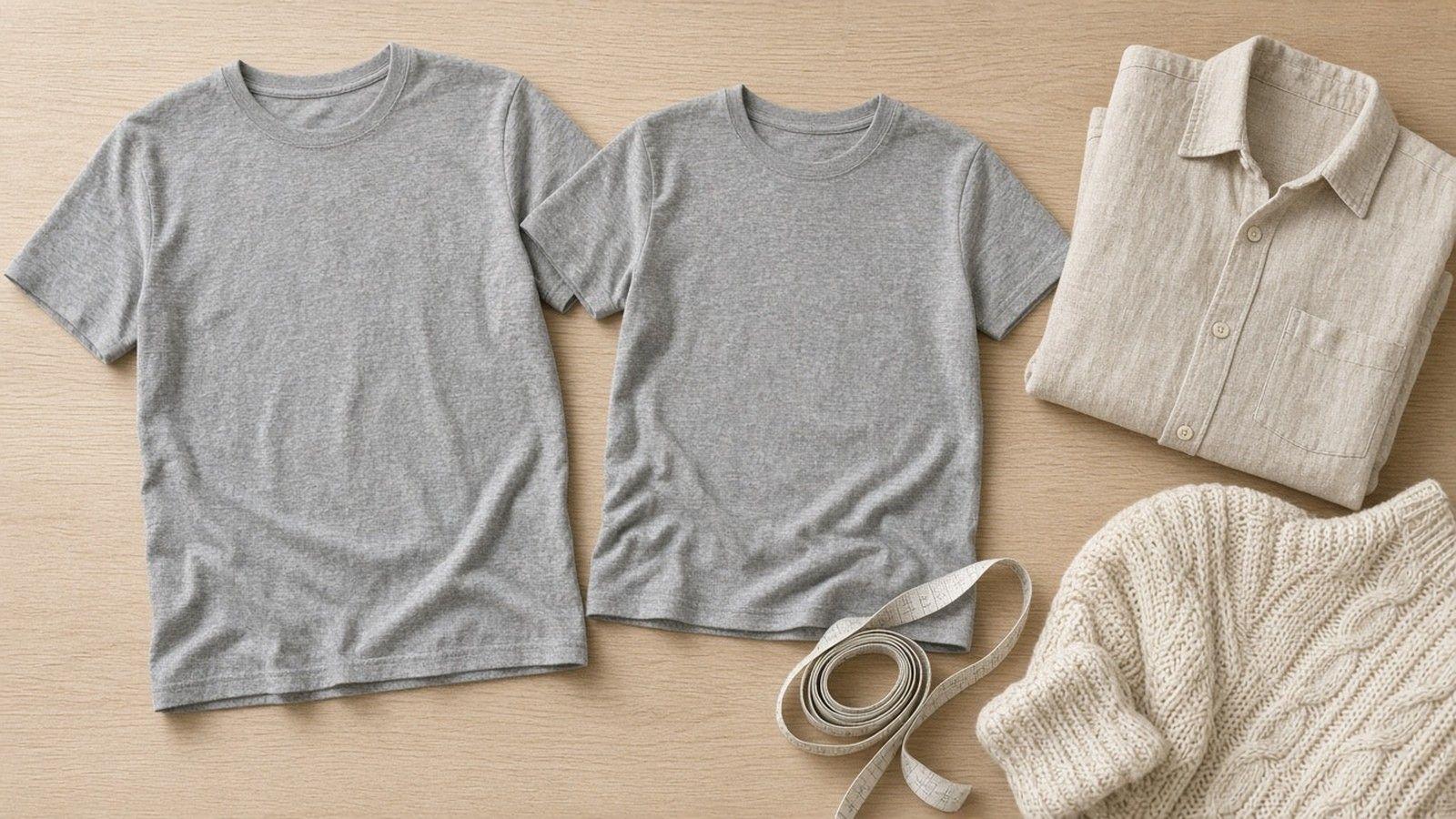
In 1970, a graduate student at Oregon State University put polyester through wash routines chosen from a survey of local homemakers. Nancy Ann Palmer washed four polyester double knit fabrics ten times each in hot, warm and cool water, dried them two different ways, and measured how much they shrank. She also had shirts made from two of the fabrics, and four-year-olds at a nursery school wore them for eight-hour stretches, with a hot wash and a tumble dry after each one, so she could check them for snags and pilling (Palmer, Oregon State University, 1970).
Hot water, which in her test was 60°C (140°F), shrank the fabrics the most, up to 2.75 percent. After ten washes in cool water, the most any of them shrank was under 1.75 percent.
Those were 1970 double knits rather than today's T-shirts, so take the exact numbers loosely, but it's the clearest test we've found, and the answer it gives is that polyester does shrink a little and hot water is the biggest reason.
Does polyester shrink?
Yes, a little. On a 28-inch shirt, 2.75 percent works out to about 3/4 of an inch, and that was the top of Palmer's range, in hot water.
The American Fiber Manufacturers Association lists polyester as "resistant to stretching and shrinking", and the University of Georgia's extension guide to fibers lists "superior wash-wear performance" among its advantages (UGA Extension, Understand Your Fibers). The AFMA's care tips say most polyester can be machine washed and dried, and suggest warm water and a low dryer temperature.
Two details from Palmer's study are useful if you're washing polyester at home:
- Water temperature mattered most. She found wash water temperature was "the most important factor" for how much the fabric changed size. The dryer mattered too, but less.
- It kept shrinking a little. Shrinkage continued after five and ten washes, though at a slower rate each time.
Her recommendation for ready-made garments was cool wash water, because total shrinkage stayed lower even after ten washes.
Why polyester behaves differently with heat
Polyester is a synthetic polymer, and the AFMA says the most common one for fiber is PET, which is also the polymer used for many soft drink bottles.
Palmer's thesis calls polyester a thermoplastic fiber and notes it's likely to crease at temperatures above 50 to 60°C (122 to 140°F). Heat is also why polyester can hold pleats that were set into it on purpose: UGA lists "retains heat-set pleats and creases" as an advantage and "melts, if too hot" as a limitation. So with polyester and high heat, the bigger worry is the fabric melting or deforming, especially under an iron (the AFMA suggests a moderately warm one), more than the shirt coming out a size smaller.
If you're comparing the two fibers for a specific garment, we went through that in polyester vs cotton.
Can you shrink a polyester shirt on purpose?
Not reliably. Washing and a long, hot dry can shrink cotton, as the next section explains, but with polyester, Palmer's hot-water results topped out at 2.75 percent, and pushing the heat higher mostly gets you closer to the "melts, if too hot" problem UGA warns about.
Blends are different. A cotton and polyester tee can still shrink, because the cotton part can. Check the fiber line on the label to see how much of the garment is cotton.
Does cotton shrink?
Yes, 100% cotton can shrink, and most of it happens in the first wash.
The National Cotton Council explains it as two different kinds of shrinkage (Cotton and the Consumer, PDF):
- Relaxation shrinkage: yarns and fabric get stretched under tension while they're made. Washing or steam releases that tension and the fabric pulls back to its natural size.
- Progressive shrinkage: the fiber itself shrinks a bit more every wash. The Council gives wool as the example, not cotton.
The dryer plays a part too. The Council says that if cotton is left in the dryer too long, the heat can cause shrinkage, and recommends taking it out once the wrinkles and moisture are gone.
What "preshrunk" and "Sanforized" mean
We haven't found a standard number behind "preshrunk" on its own (the Cotton Council's leaflet just says sanforized cotton "has been preshrunk"), but "Sanforized" has one. The Sanforized trademark sets a shrinkage standard: woven fabric carrying the label can't shrink or grow more than 1 percent in either direction under the ISO 6330 wash test, with up to 1.5 percent more allowed after tumble drying and garment making. For knits under the Sanfor-Knit label, the limit is 5 percent.
So a Sanforized woven shirt can still shrink a little, but under that standard it's capped at a couple of percent.
Does linen shrink?
It can, and the dryer is where the linen industry warns about it. The Alliance for European Flax-Linen and Hemp says linen is perfectly suitable for machine washing, but warns that in a tumble dryer "excessive heat can alter the quality of the fabric and possibly cause shrinkage" (linen care advice).
For a linen shirt, they suggest a delicate cycle at no more than 30°C (86°F), a low spin, and drying in the open air, in the shade. If you do use the dryer, they suggest a low setting and taking linen out while it's still slightly damp. Our guide to what linen is made of covers the fiber itself.
Does rayon shrink?
It can. Under the FTC's fiber definitions (16 CFR 303.7), rayon is a manufactured fiber of regenerated cellulose, and it's also sold as viscose.
UGA's extension guide lists rayon as "weaker when wet" and says it "may shrink or stretch, unless treated," and that rayon fabrics need careful handling in the wash. So if a rayon dress or blouse says hand wash or cold water, follow it.
Does wool shrink?
Yes, and wool shrinkage is the kind you can't undo. Woolmark explains that wool fibers are covered in microscopic scales. With heat and moisture the scales lift, and with agitation they lock onto each other "in a ratchet-like mechanism" (Woolmark, machine washable wool), which is how wool felts and shrinks, and Woolmark calls the process irreversible.
Machine washable wool (Woolmark notes it's sometimes known as superwash) is treated to smooth the scales or keep fibers from gripping each other. If a wool sweater doesn't say it's machine washable, assume it isn't. We cover the treatments in what is merino wool.
Can you unshrink clothes?
It depends on why they shrank.
- Felted wool: no. Woolmark says that process is irreversible.
- Cotton that shrank from relaxation: the fabric pulled back toward its natural size, so there isn't a stretched version for it to go back to on its own. Stretching tips are all over the internet, but we haven't found testing on how well they hold.
- Polyester: Palmer's numbers suggest any shrinking will be small. If heat melted it, that won't come back.
The cheaper fix is not shrinking things in the first place, which mostly means reading the label correctly.
How to read the care label so things don't shrink
In the US, the FTC's Care Labeling Rule sets what care labels mean (16 CFR Part 423). A few parts of it change how you should read a label:
- "Machine wash" with no temperature means hot water up to 145°F (63°C) can be used regularly. If a garment would be harmed by hot water, the label is supposed to give a temperature.
- "Tumble dry" with no setting means a high, medium or low setting can be used.
- Warnings have to say so. If a washing step you'd reasonably use would harm the garment, the label must warn against it with words like "Do not," "No" or "Only."
- The brand needs a reason. Under the rule, a manufacturer or importer must have a reasonable basis for its care instructions, like testing or reliable evidence.
The rule's glossary also defines the temperature words: "cold" is water up to 86°F (30°C), "warm" is 87 to 111°F (31 to 44°C), and "hot" is 112 to 145°F (45 to 63°C).
So when a label says "Machine wash cold, tumble dry low," take it literally. When it says only "Machine wash, tumble dry," the brand is saying hot water and a high dryer setting won't harm it.
When we look at a new piece of clothing, this is the order we check things in:
- The fiber line. Polyester, cotton, linen, rayon and wool all shrink differently, and in a blend each fiber still behaves its own way.
- The care label. Read the temperature and dryer setting, or the absence of them, the way the FTC rule defines them.
- Words like "Sanforized" or "machine washable wool." Those have a real standard or treatment behind them, while "preshrunk" alone tells you less.
If a product page doesn't list fiber content or care, ask the brand before you buy. Greener Closet scores what a listing discloses, and fiber content is a big part of that. Shrinkage isn't something a fiber line can promise, but it tells you which of the sections above applies to the thing in your cart.