
What Is Linen Made Of? Flax, How Linen Is Made, and Linen vs Cotton
Organization-authored. Editorial policy · Report an error
In a cave in the foothills of the Caucasus, in what's now Georgia, archaeologists found wild flax fibers in layers dated to roughly 32,000 to 26,000 years ago. Some were spun, some were knotted, and some had been dyed (Kvavadze et al., Science, 2009).
Linen is still made from flax, though today it comes from a farmed variety rather than the wild plant in that cave. So when a shirt tag says "100% linen," it's telling you about a stalk from a field. Below is what linen actually is, how a plant stem turns into fabric, how linen compares to cotton, and what to look for on a label so you get the real thing.
What is linen made of?
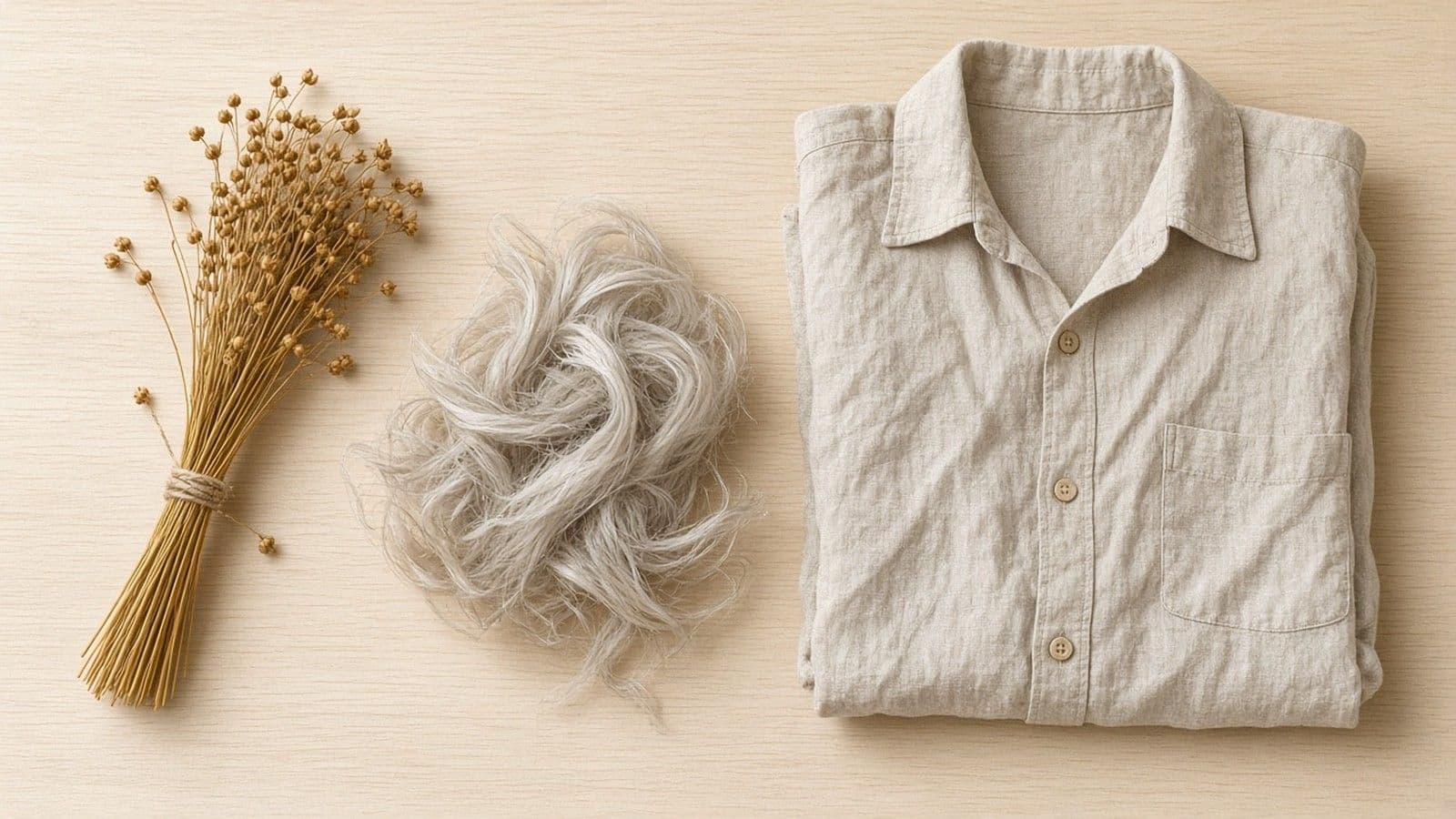
Linen is made from the fibers inside the stem of the flax plant. The European Commission's page on flax describes the long flax fibers as the raw material for linen, which is combed, spun and woven into fabric.
Flax fibers are what's called bast fibers. The Alliance for European Flax-Linen & Hemp, the industry group for European growers and mills, explains that bast fibers come from the stem of the plant rather than its flowers. Hemp and jute are bast fibers too.
Flax is also the plant flaxseed (linseed) comes from. The Alliance notes that fiber flax and oilseed flax have been treated as two distinct types since the end of the 1800s, so the flax in your shirt isn't the same crop as the flax in your granola.
How is linen made, from field to fabric?
There's less chemistry in the basic process than you might expect. According to the European Commission:
- Growing. Flax is sown in March and April and grows for about 100 days, reaching around one meter tall.
- Pulling. The whole plant is pulled out of the ground instead of cut, so the fibers stay as long as possible.
- Retting. The stems are laid out in rows on the field for several weeks and turned regularly. Microorganisms break down the pectin that glues the fibers to the woody core.
- Scutching. The retted stems are crushed and beaten by machine to separate the fibers from the woody parts.
- Spinning and weaving. The long fibers are combed, spun into yarn and woven into fabric.
Retting is the step that varies most. The Alliance says its certified European flax is 100% dew retted, meaning it's left on the ground to rain and dew, "in contrast to water retting, used in other regions of the world" (Alliance, environmental features). The same page says European flax is generally grown without irrigation, with exceptions in serious drought.
What the fiber process doesn't tell you is what happened after weaving. Bleaching, dyeing and finishes are separate steps, and they're where most of the chemistry in any fabric shows up. More on that below.
Where does linen come from?
Most of the world's long flax fiber is grown in a narrow coastal strip of Western Europe. The Alliance says three-quarters of global long flax fiber comes from France, Belgium and the Netherlands, with France the biggest producer (Alliance, 2023 market figures).
Growing and spinning often happen in different places, though. The European Commission notes that spinning and weaving are mainly done outside the EU. A "French flax" shirt may have been spun and sewn somewhere else, so if origin matters to you, check what the brand says about each step, not just the fiber.
Flax is also a small fiber overall. The Alliance's figures put flax at less than 0.5% of global textile fiber production. That's part of why linen costs more than cotton.
Linen vs cotton: what's actually different?
Both are plant fibers, and both are cellulose. The big difference is which part of the plant they come from. Cotton grows as fluffy hairs attached to the seeds inside the cotton boll. Linen comes from the stalk. That changes how the fabric behaves.
Feel and wrinkles. Linen fibers are long and stiff compared with cotton, which is why linen feels crisp at first and creases easily. It softens with washing. Cotton is softer out of the bag and holds a press better.
Breathability. Linen has a reputation for feeling cool in summer. The Alliance describes long flax fibers as "moisture absorbent and thermoregulating." We'd call that a fair description of how it wears in hot weather, but we haven't found an independent study comparing linen and cotton head to head that we'd want to quote numbers from.
Growing. The European Commission says flax is rain fed, needs little fertilizer and is grown in rotation every six to seven years. Cotton growing varies hugely by region and farm, so we'd rather not put one number on it here. Our polyester vs cotton post and our post on organic cotton go into cotton in more detail.
Price. Linen usually costs more. Flax is a small crop, and the Alliance's 2023 report describes flax prices as historically high, with demand for natural fibers growing faster than production.
If you're choosing between the two for summer clothes or sheets, linen tends to win on feeling cool and cotton tends to win on softness and fewer wrinkles. Neither one is a bad pick.
What does "linen blend" or "linen look" mean on a label?
This is where people get caught out. Linen is popular and pricey, so a lot of clothing borrows the word.
- "100% linen" should be all flax fiber, apart from things like thread and trim. Our post on what "exclusive of trim" means covers what a fiber label does and doesn't include.
- "Linen blend" can mean almost any amount of linen. Check the percentages on the care label. A blend that's mostly viscose or polyester with a little linen is a different fabric than one that's mostly linen. Our post on whether viscose is safe explains that fiber.
- "Linen look," "linen texture" or "linen-like" in a product name describes the appearance. It doesn't tell you there's any flax in it at all. The fiber content on the label is the only part that does.
The same goes for online listings. If a product page says "linen" in the title but doesn't list fiber percentages anywhere, we'd treat that as unknown until the brand says.
Does linen have finishes or chemicals on it?
The fiber itself is just plant cellulose, but finished fabric can carry dyes and treatments like any other fabric. One worth knowing about is wrinkle resistance. A U.S. Government Accountability Office report found that formaldehyde "can be used to enhance wrinkle resistance in some clothing and textiles, especially those made of cotton" (GAO-10-875). In the items GAO had tested, formaldehyde levels were mostly low or not detectable, though the report also says allergic contact dermatitis is a real health issue for some people.
Linen wrinkles easily, so "easy care," "non-iron" or "wrinkle-free" linen is worth a second look. Ask the brand what finish was used. A plain linen shirt that creases is usually a sign nobody tried to stop it from creasing.
How to check a linen piece before you buy
- Read the fiber percentages, not the product name.
- Look for where the flax was grown and where the fabric was spun and woven, if the brand says. The Alliance's Masters of Linen label confirms the linen was processed in Europe by European businesses.
- Be a little skeptical of linen sold as wrinkle-free, and ask what the finish is.
- Expect it to crease and soften over time, which is just how flax fiber behaves.
When you're browsing, Greener Closet reads the fiber content a listing discloses and scores it while you shop. If a listing doesn't say what it's made of, we can't make that up, and we'll tell you it's missing.