
Terry Cloth Robe vs Plush Robe: How to Find a 100% Cotton Bathrobe
A terry cloth robe is a towel you can wear, and it's usually cotton. Plush and coral fleece robes are often polyester. How terry, waffle, flannel and velour robes compare, why cotton robes can feel thin, and how to check a listing for 100% cotton.
Organization-authored. Editorial policy · Report an error
"Coral fleece" has nothing to do with coral. It's a knitted fabric, usually made from polyester yarn, that gets brushed and finished into a fine plush surface, and one fabric supplier that sells it lists bathrobes first among its common uses (WellDoneTex).
That explains a lot about robe shopping. Search for a soft robe and the descriptions lean on words like plush, fluffy and "coral fleece," which describe how the robe feels. The fibers behind those words are often polyester, and when you do find a cotton robe, it can look thin next to all that pile.
If you want a robe that's actually cotton, terry cloth is usually the word you're looking for. Below is what terry, waffle, flannel and velour robes are made of, how they compare to polyester plush, and how to check a listing before you buy.
What is a terry cloth robe?
A terry cloth robe is a robe made from the same looped fabric as a bath towel. Terry is woven with lots of protruding loops of thread that can absorb a lot of water (Wikipedia, Terrycloth). Wikipedia says towel terry is "usually 100% cotton, but may sometimes contain polyester," and that longer loops absorb more because they give the water more surface to touch.
So a terry robe is basically a towel you can wear, and that's how Wikipedia's bathrobe entry describes a bathrobe: a dressing gown made from towelling or another absorbent fabric that can go on while you're still wet, "serving both as a towel and a body covering."
The "Turkish" name on towels goes back a long way, too. The English towel maker Christy started industrial terry production in 1850 after studying handwoven terry in Turkey, and Queen Victoria approved the name "Royal Turkish Towels" (Wikipedia, Terrycloth).
Is a terry cloth robe cotton?
Usually, but check. Terry describes how the fabric is made, with those loops, so it can be made from more than one fiber. A 2005 review of terry towel production in the Journal of Textile and Apparel, Technology and Management (NC State) says 100% cotton yarns are the most common choice for the loops, and that cotton-rayon blends have become less common because all-cotton gives a nicer hand. It also mentions cotton-polyester yarn used for strength in the base yarns that hold the loops, and more towels being made from fibers like modal, bamboo and lyocell.
The same review gives the reason cotton dominates: cotton "wets easily, and can hold much more water than synthetic fibers can." It also notes cotton dries slowly, which is the tradeoff with a heavy cotton terry robe: it dries you well and then takes a while to dry itself.
What's the best bathrobe material?
It depends on what you want the robe to do. Wikipedia's bathrobe entry sorts robes by fabric, and that's a more useful way to shop than by brand.
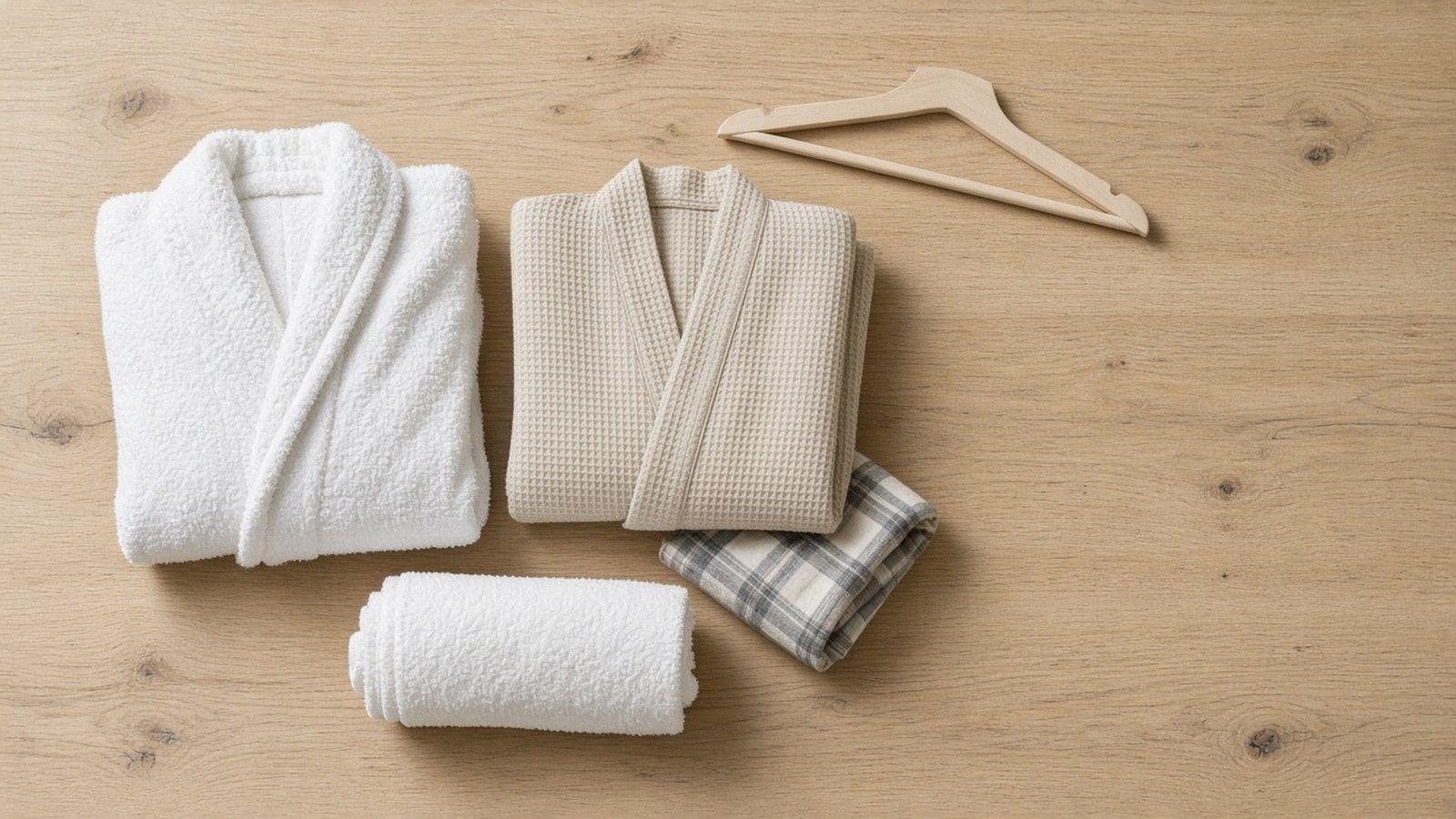
- Terry cloth. Looped pile, usually cotton. Wikipedia says the longer and denser the loops, the more absorbent the robe. This is the one to get if you put it on straight out of the shower.
- Waffle. A grid-textured weave, also called honeycomb fabric (Wikipedia, Waffle fabric). Wikipedia's bathrobe entry says waffle fabric has good water absorbency, but waffle robes are designed for light weight over absorbency, so it's the one to pick when you want something light.
- Flannel. Wikipedia's bathrobe entry calls it a soft woven fabric, "usually cotton or wool," and Wikipedia's flannel entry says it may be brushed to raise a soft nap (Wikipedia, Flannel). We'd pick it for lounging rather than drying off. Flannel can also be synthetic, so a "flannel robe" isn't automatically cotton. We covered that in what is flannel.
- Velour. A pile fabric where the loops are cut. Wikipedia says velour robes are typically lined with terry, "as terrycloth absorbs water better than velour." The NC State review says the same thing from the towel side: uncut loops give the best absorbency, while velour gives a velvety hand. Velour can be polyester, cotton or a cotton-polyester blend (Wikipedia, Velour), and the example photo on that page is a 100% polyester velour bathrobe.
- Plush, coral fleece and microfiber. Usually polyester, and sold on softness and warmth. More on these below.
If you only want one robe and you use it after showers, cotton terry is the best bet. If you mostly wear a robe for warmth on the couch, cotton flannel makes more sense.
Is a "plush" robe polyester?
Often, yes, but "plush" describes how the fabric feels, so on its own it can't tell you what the robe is made of.
The common plush words break down like this:
- Coral fleece is a knitted fleece, usually polyester, brushed and finished into a smooth plush surface (WellDoneTex). Another fabric supplier says coral fleece is usually made from 100% polyester, "although some blends may exist."
- Microfiber is about how fine the fiber is. Wikipedia defines it as synthetic fiber finer than one denier, most often polyester, polyamide (nylon) or a mix (Wikipedia, Microfiber). We went deeper in what is microfiber.
- Fleece isn't a fiber name either. Polar fleece, the kind in jackets and blankets, is a soft, napped polyester fabric (Wikipedia, Polar fleece). More in what is fleece fabric.
Under US labeling rules, the fiber line has to use generic fiber names like "cotton" or "polyester" for any fiber that's 5% or more of the fiber weight (16 CFR 303.6). "Coral fleece" won't count as one.
Do polyester robes absorb water?
Less than cotton terry, in general, though the sources don't line up perfectly and the fabric's construction matters a lot.
Wikipedia's terrycloth entry describes microfiber as a "modern cheaper alternative" to terry for towels, calling it "nonabsorptive (but somewhat wicking)." The NC State review is kinder to microfiber towels made for absorbency. It says split microfiber towels "can absorb 5 to 7 times their weight in water."
Those are towels built to absorb, while a plush coral fleece robe is built for a different job, and the supplier pages above sell it on softness and warmth rather than on drying you off. WellDoneTex also says the name alone doesn't tell you how much a coral fleece sheds or how breathable it is, since that comes down to the exact fabric.
So if a polyester plush robe feels warm but leaves you damp, that fits what these sources say: it was made for softness and warmth rather than drying. If you're weighing polyester against cotton more broadly, we compared them garment by garment in polyester vs cotton.
Why do 100% cotton robes feel thin?
One likely reason is weight: cotton terry comes in light and heavy fabrics, and the listing may not say which one you're getting.
Terry comes in a wide range of weights. The NC State review classifies terry towels by weight: light at 250 to 350 grams per square meter (GSM), medium at 350 to 450, heavy at 450 to 550, and very heavy above 550. Those bands are for towels rather than robes, but they give you a scale, so a robe listing with a GSM number lets you compare, and one without it is leaving out the most useful number for "will this feel thin?"
Two other things change how thick a robe feels:
- One-sided vs two-sided loops. The NC State review says terry with pile on only one side has low water absorbing capacity and is "only used for special purposes such as a limited number of bathrobes." Two-sided terry has loops on both faces.
- Waffle vs terry. A cotton waffle robe is built lighter than terry on purpose, which is the trade Wikipedia describes, so a thin waffle robe isn't necessarily a bad one.
If you want a cotton robe that feels substantial, look for two-sided terry with a GSM number toward the heavier end. If the listing doesn't give a weight, ask.
How to tell if a robe is 100% cotton from the listing
Before you buy, check these on the product page:
- Find the fiber line, not the title. The title might say "plush" or "luxury," but only the fiber line, the part that says "100% cotton" or "100% polyester," tells you what it's made of.
- Read every percentage. "80% cotton, 20% polyester" is a blend. The FTC requires fibers to be listed in order of weight, and fibers under 5% are normally grouped as "other fiber" (FTC labeling guide).
- Watch for split fabrics. A velour robe with a terry lining might list two different fabrics, or it might not list the lining at all, since the FTC guide lets most linings off the fiber label unless they're there for warmth. If you want all cotton, make sure every fabric it names says cotton, and ask about the lining if it isn't named.
- Don't trust "cotton-like" or "feels like cotton." US rules say words, coined words or spellings that imply a fiber that isn't present can't be used to suggest that fiber is in the product (16 CFR 303.18). A vague description might still slip through, so the fiber line is what you go by.
- Check trim. Some labels say "exclusive of trim," which leaves out parts the FTC counts as trim, like collars, cuffs and binding. We explain that in what "exclusive of trim" means.
- No fiber listed at all? Ask the brand before you buy. If a listing names a fiber or a fiber trademark in its ad copy, the FTC rules say the fiber content has to be disclosed at least once in the ad (16 CFR 303.41). A listing that only says "plush" may never name a fiber at all.
That last case is the one that bugs us most, because Greener Closet scores what a listing discloses, so if a robe page never says what it's made of, we can't fill that in, and you shouldn't have to guess either.
What about robes for kids?
Kids' robes can fall under the US children's sleepwear rules. The CPSC's children's sleepwear standards cover "nightgowns, pajamas, or similar or related items, such as robes" in sizes up to 6X (16 CFR 1615.1) and sizes 7 through 14 (16 CFR 1616.2). Those standards set flame tests, and the definitions carve out a few exceptions, including tight-fitting garments.
A robe is loose by design, which makes the tight-fitting route hard. We walked through what that usually means for cotton kids' sleepwear, including flame retardant finishes, in our flannel guide. For a cotton kids' robe, the fair question to ask the brand is how it meets the sleepwear standard: is it the fabric itself or a treatment, and which one?
What to search for when you want a cotton robe
If you're shopping for a cotton robe for yourself or as a gift, the search terms that tend to pull cotton results are more specific than "soft robe":
- "100% cotton terry robe"
- "cotton waffle robe"
- "cotton flannel robe"
- "Turkish cotton robe" (still check the fiber line, since the word "Turkish" doesn't tell you the whole robe is cotton)
Then open the fiber line on each result before you add it to the cart. If a result doesn't list its fibers, skip it or ask the seller.